Russia-Belarus Nuclear Drill Ends as Ukraine Advances in Zaporizhia and Russia Fires 116 Drones
Threat Level Assessment
LEVEL 4 OF 5, SERIOUS
Bottom Line Up Front
Russia and Belarus completed a three-day joint nuclear exercise on 21 May involving more than 64,000 personnel, Yars ICBM launches, Sineva submarine launches, and the first-ever direct presidential participation by Putin and Lukashenko, in what ISW assesses as a demonstration of Russia's deepening de facto control over Belarus. Ukrainian forces advanced in western Zaporizhia Oblast as Russia launched one ballistic missile and 116 drones overnight, the latter the highest single-night figure in several weeks. Separately, the Kremlin is actively directing Russian media to suppress coverage of its internet censorship campaign ahead of the September 2026 State Duma elections, while Russia's federal budget deficit has reached approximately 80 billion dollars in the first five months of 2026 and Moscow continues to sell physical gold reserves to cover the shortfall.
Key Judgments
The Russia-Belarus nuclear exercise was a coercive political signal aimed at Ukraine's Western partners, not a genuine preparation for nuclear use. The unprecedented direct participation of Putin and Lukashenko, the explicit integration of Belarusian Iskander launch sites, and the timing alongside Putin's Beijing visit all point to a coordinated deterrence-signalling operation. ISW assesses the exercises as demonstrating Russia's ability to leverage Belarus for future military operations and its deepening de facto control over the country. The exercises followed a successful Sarmat ICBM test on 12 May and overlapped with Deputy Foreign Minister Ryabkov's warnings in TASS about strategic miscalculation by the West.
Ukrainian pressure in western Zaporizhia is disrupting Russia's planned spring-summer offensive design rather than representing a symmetric Ukrainian offensive. ISW has assessed since early March 2026 that Ukrainian counterattacks across the Orikhiv, Hulyaipole, and Oleksandrivka directions have forced elite Russian units to shuttle between crisis points, exposing a shortage of operational reserves. The 22 May assessment confirms Ukrainian advances are continuing in the western Zaporizhia Oblast area. Russia's 5th Combined Arms Army, which had been pushing toward Orikhiv and Hulyaipole, is being pulled into a costly positional fight rather than a westward advance.
Whether Russia's combination of fiscal stress, gold-reserve depletion, and censorship-driven domestic management can sustain current levels of military expenditure through the September Duma election cycle. The 80 billion dollar five-month deficit figure, cited by President Zelensky on 18 May, is plausible given the January-February data (3.45 trillion rubles in two months alone) but has not been independently confirmed by Russian federal fiscal releases for the full five-month period. The Kremlin's VAT increase and shadow-economy expansion are complicating factors that could accelerate or slow the fiscal deterioration.
116
Russian Drones, Overnight Strike
64,000+
Personnel, Russia-Belarus Nuclear Drill
~$80B
Russian Budget Deficit, Jan-May 2026
22 t
Russian Gold Sold, 2026 to Date
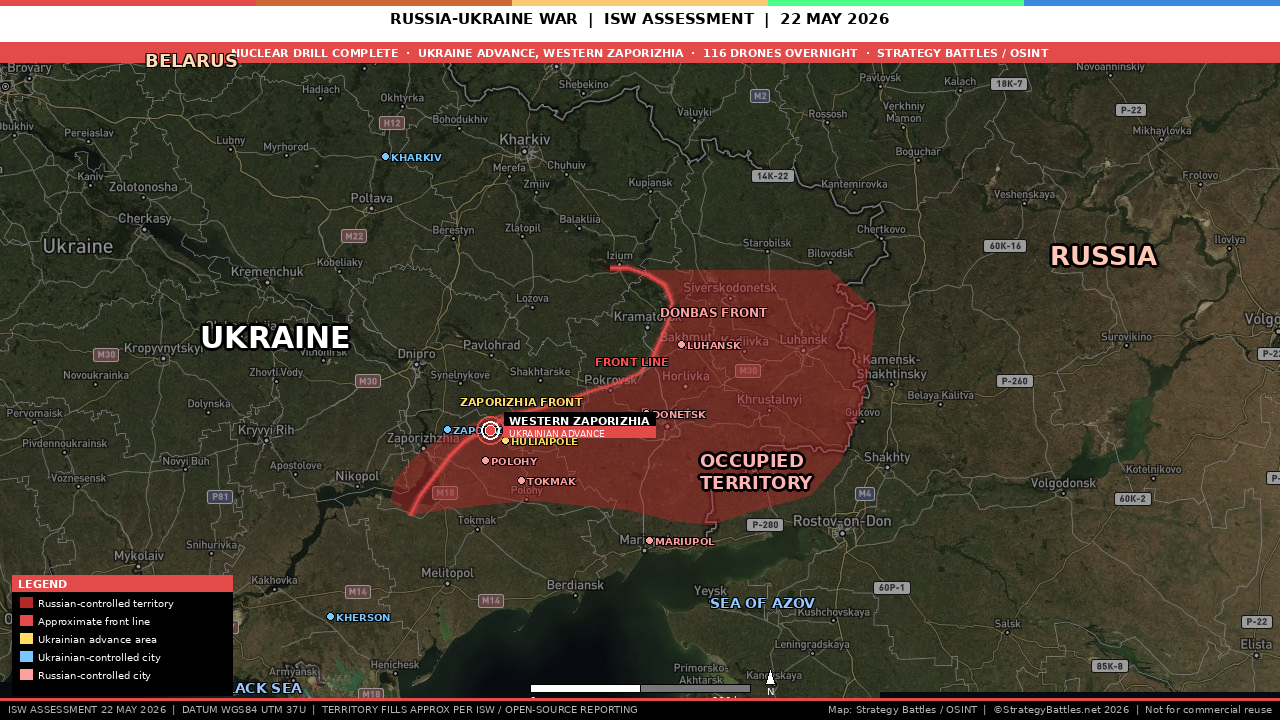
Ukraine theatre showing western Zaporizhia front contact zone, Huliaipole direction, and Belarus nuclear exercise area referenced in ISW assessment of 22 May 2026. Territory fills approximate per ISW / open-source reporting as of 22 May 2026. Map: Strategy Battles / OSINT. Datum WGS84, UTM Zone 37U. ©StrategyBattles.net 2026
📍 Huliaipole, Western Zaporizhia
INDICATIVEMGRS: 37U NB 7625 4905
47.6500°N 36.2670°E
Town in Polohy Raion, Zaporizhzhia Oblast. Ukrainian forces advanced in the surrounding direction per ISW assessment 22 May. The active front contact zone lies south and southeast of the town; it is plotted as an area, not a precise point.
Source: Wikipedia infobox, town centroid. Village-level accuracy, approximately 500m to 5km.
📍 Western Zaporizhia Front Contact Zone
AREA ONLYApproximate Area
Centre of indicative zone. Exact front positions not publicly resolved.
The active contact zone in the Orikhiv-Hulyaipole corridor runs across approximately 80 kilometres of front. ISW does not publish real-time grid-level positions; only indicative area plotted here, roughly 20 kilometres south of Zaporizhzhia City.
Source: Approximate per ISW maps and open-source reporting. Front positions not published at grid precision.
📍 Plesetsk Cosmodrome, Russia
PRECISEMGRS: 37V PE 1490 7250
62.9250°N 40.5740°E
Launch site of the Yars ICBM fired during the Russia-Belarus joint nuclear exercise, 19 to 21 May 2026. Missile targeted the Kura range on the Kamchatka Peninsula per Russian Defense Ministry statement carried by AP.
Source: GeoNames gazetteer / Wikipedia, known military-strategic launch facility.
📍 Zaporizhzhia City, Ukraine
PRECISEMGRS: 37U MB 5840 6990
47.8380°N 35.1400°E
Ukrainian-controlled regional capital. The Russian military command has stated an objective of advancing within tube artillery range of Zaporizhzhia City. The Orikhiv-Hulyaipole front sits approximately 50 to 80 kilometres to the south and southeast. Cross-check reference point for map orientation.
Source: GeoNames gazetteer / Wikipedia city article.
SITREP Timeline : Key Events Leading to the 22 May Assessment
🔴 The Nuclear Exercise
Putin and Lukashenko at the Situation Centre: A Three-Day Drill Designed to Be Seen
The Russia-Belarus nuclear exercise that concluded on 21 May was, by the Russian Defense Ministry's own accounting, the largest nuclear readiness drill conducted with a foreign partner since the Soviet era. More than 64,000 personnel, over 200 missile launch platforms, 140 aircraft, 73 surface warships, and 13 submarines, including eight carrying nuclear-tipped intercontinental ballistic missiles, took part across three days. The ministry asserted that strategic and hypersonic missiles were launched from land, sea, and air, with all targets accurately engaged. ISW assessed these claims as assertions of the Russian Defense Ministry and noted they cannot be independently verified against closed-range test data.
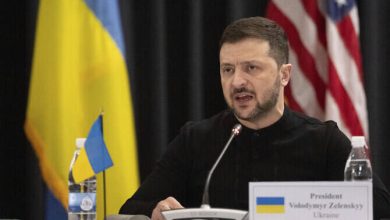
What is independently documented is the political dimension. Putin and Lukashenko participated directly via video conference from the Presidential Situation Centre at the Kremlin, the first time both presidents have done so in a nuclear exercise, according to TASS. The joint release of footage showing nuclear munitions arriving at field storage sites across Belarus, and Lukashenko's public statement that he had secured Russian Iskander-M systems in fulfilment of a "dream," were clearly calibrated for international consumption. Defense News reported separately that the exercise was unannounced before it began, distinguishing it from the announced tactical drills of May 2024.
The Plesetsk cosmodrome, at approximately MGRS 37V PE 1490 7250 (62.925°N, 40.574°E) in Arkhangelsk Oblast, was the declared launch site for the Yars ICBM, aimed at the Kura test range on Kamchatka. A Sineva submarine-launched ballistic missile was fired from a vessel in the Barents Sea. Both launches are standard components of Russian nuclear readiness certification exercises and do not in themselves indicate heightened operational intent. What does carry analytical weight is the simultaneous Oreshnik integration on Belarusian territory, the timing alongside the Putin-Xi summit in Beijing, and Ryabkov's parallel rhetoric in TASS about strategic miscalculation. ISW's judgment that the exercises highlight Russia's deepening de facto control over Belarus is supported by the explicit forward-basing logic: Oreshnik stationed in Belarus since 2025 places intermediate-range nuclear delivery systems some 800 kilometres closer to western European capitals than positions on Russian territory.
Ukraine's foreign ministry condemned the exercises as a violation of the Treaty on the Non-Proliferation of Nuclear Weapons. The State Border Guard Service stated that it was continuing to fortify the full length of the Ukraine-Belarus border, and a Ukrainian OSINT spokesperson described the border as a "risk zone" from which Russia, or Belarus under Moscow's pressure, could "more massively join the war." The border service's language is consistent with its posture since late 2025, when Russian reconnaissance assets began intensifying activity in the Sumy border corridor.
🟡 Western Zaporizhia
Ukrainian Advances Disrupt Russia's Offensive Design for a Second Consecutive Month
ISW's 22 May assessment confirmed that Ukrainian forces advanced in western Zaporizhia Oblast overnight. This continues a pattern that ISW has tracked since early February 2026, when Ukrainian counterattacks across the Orikhiv, Hulyaipole, and Oleksandrivka directions began forcing Russian forces onto the defensive on what had been an axis Russia intended to develop into a thrust toward Zaporizhzhia City. The front contact zone runs south and southeast of the Huliaipole town centroid at MGRS 37U NB 7625 4905 (47.650°N, 36.267°E), across a corridor roughly 80 kilometres wide.
The significance of the Zaporizhia advances is not territorial in the immediate sense. ISW assessed in March 2026 that if the current rate of Russian advance in the Hulyaipole direction continued unchanged, Zaporizhzhia City's defensive ring would not be tested for more than a year. What the Ukrainian counterattacks have done is structural: by forcing Russia's 5th Combined Arms Army and supporting airborne units to shuttle between crisis points in the Orikhiv and Hulyaipole sectors simultaneously, Ukraine has degraded Russia's ability to concentrate mass for a single breakthrough. The ISW May 19 assessment noted Russian forces continuing limited ground attacks in the Zaporizhia Oblast but failing to advance as Ukrainian forces counterattacked. The 22 May update confirms Ukrainian momentum in the area has not reversed.
The 116-drone overnight strike and the single ballistic missile launch are consistent with Russia's sustained air campaign pattern, which exceeded 8,000 drones in April 2026 alone according to CSIS data cited by Russia Matters. Russia has been systematically targeting Ukrainian energy infrastructure, logistics nodes, and air defense systems across the theatre. The overnight strike on the night of 21 to 22 May falls within this pattern rather than indicating a specific tactical escalation tied to the nuclear exercise.
🔵 Russia's Fiscal Position
An 80-Billion-Dollar Deficit, 22 Tonnes of Gold, and a VAT Increase That Made Things Worse
ISW's assessment on 22 May identifies two converging economic pressures on Russia: the ongoing attrition of oil refinery capacity through Ukrainian strikes, and gold reserve depletion to cover mounting federal deficits. The Bank of Russia has sold approximately 22 tonnes of gold since the start of 2026 to fund the budget gap. By end of March 2026, the deficit had reached 4.6 trillion rubles, equivalent to approximately 61 billion dollars at prevailing exchange rates, driven by lower oil and gas revenues at the opening of the year and expenditures running some 5.8 percent higher than the same period in 2025. The five-month deficit of roughly 80 billion dollars, cited by Zelensky on 18 May, represents a trajectory that has accelerated through April and May.
ISW identifies a short-term complicating factor: the Middle East war that began in early 2026 has generated elevated oil prices that provide Russia a temporary budget windfall. This is an accurate structural point. Russia's oil and gas revenues are sensitive to global spot prices, and any sustained price spike benefits Russian export receipts. The windfall does not, however, offset the underlying structural problem: nearly 40 percent of Russia's oil refining capacity has been forced offline by Ukrainian drone strikes, according to Russian energy market data cited by Russia Matters as of October 2025, with at least 70 percent of those shutdowns linked directly to Ukrainian strikes. Exporting crude rather than refined products carries a significant margin penalty.
The January 2026 VAT increase was intended to compensate for the oil revenue shortfall. ISW assessed in its May 3 and May 18 briefings that the policy has had the opposite of its intended effect: businesses and consumers have shifted to cash transactions to avoid the higher tax, expanding Russia's shadow economy and increasing the cost of goods and services without generating the desired fiscal return. The sovereign wealth fund's liquid reserves, which Russia relied on through 2022 to 2024, have been substantially depleted. Physical gold sales are the residual mechanism. ISW notes that Russia's cumulative economic growth in 2022 to 2025 reached 8 percent, but that the structural costs of sustaining the defense budget are compounding in ways that cyclical oil price movements cannot fully compensate.
⚠ The Duma Elections Angle
The Kremlin Is Trying to Ban the Word "Ban": Media Manipulation Ahead of September 2026
The fifth key takeaway in ISW's 22 May assessment addresses the Kremlin's active direction of Russian media to downplay its own censorship campaign. The context, developed in the ISW March 12 assessment and confirmed by Dagens.com reporting on 22 May, is straightforward: Russia's internet censorship drive, which has throttled Telegram access, restricted VPNs, and banned or blocked major Western social media platforms, has generated significant domestic backlash. A Russian Telegram channel commenting on political affairs described the censorship effort as "madness" and assessed it has destroyed the "narrative of unity" that the Kremlin has relied on to maintain public cohesion.
The presidential administration's response, per Dagens.com citing sourced reporting, is to instruct media outlets to highlight "positive and therapeutic" initiatives from United Russia and to promote party members who publicly speak against state prohibitions. The United Russia General Council Secretary Vladimir Yakushev made a public statement on 19 May insisting the party is not a "party of prohibitions." This is a rebranding effort, not a policy reversal. The Kremlin's internet controls are intensifying, not relaxing. The political problem being managed is that this contradicts the messaging United Russia needs ahead of the 18 to 20 September 2026 State Duma elections, in which all 450 seats are at stake.
ISW's March assessment noted the Kremlin may be building out internet controls ahead of a future conflict with NATO, and that Putin may not be as confident in regime stability as public posture suggests. The Duma elections provide a more immediate explanatory variable: the Kremlin needs United Russia to appear competent and non-repressive in a wartime context where reserve call-up announcements, economic constraints, and information restrictions are all simultaneously unpopular. Managing the appearance of the censorship campaign is a more tractable short-term problem than ending it. The trajectory through September will likely involve continued media management, possible minor visible relaxations in minor Telegram-related enforcement, and intensified suppression of opposition platforms including Yabloko, which ISW-adjacent electoral monitoring agencies note faces designation as an extremist organisation at any moment.
Alexander Lukashenko : Belarusian President, Statement at Conclusion of Nuclear Exercise, 21 May 2026
"I once dreamed about this, and now we have more than one. It's a good weapon."
Source Reliability Matrix
NATO grading: REL A (reliable) to F (unreliable). CRED 1 (confirmed) to 6 (cannot judge).
Primary analytical source. ISW draws only on publicly available information, commercial satellite imagery, and open-source reporting. Carries endnotes. Accessed via Kyiv Post and SPARTANAT digests.
Wire service. Russian Defense Ministry figures for personnel and equipment counts are Moscow's own assertions and not independently verified, but their publication via AP carries standard wire attribution standards.
Established Ukrainian English-language outlet. Sourced from RFE/RL Belarus service Svaboda and Russian and Belarusian defense ministry statements. Pro-Ukrainian editorial stance; factual reporting assessed consistent and reliable over time.
Wire service. Presidential participation confirmed by TASS and Kremlin pool photography. First-time presidential participation in nuclear exercise cross-confirmed by AFP sourcing in Al Jazeera report.
Ukrainian government-affiliated outlet. Gold figures sourced to Moscow Exchange and Moscow Times data. Figures consistent with ISW May 18 assessment and TradingEconomics Russia budget data. Interested-party caveats apply but underlying fiscal data is public record.
Personnel and equipment counts, launch descriptions, and outcome claims are Russian MoD assertions. Presented throughout as assertions. Not independently verified against closed-range telemetry or satellite confirmation.
Strategy Battles Assessment
Russia is running nuclear signalling, a 116-drone overnight campaign, and a media-management operation simultaneously: the common thread is a Kremlin managing more pressure than its public posture admits.
✓ What We Know
Russia and Belarus completed a three-day joint nuclear exercise on 21 May involving 64,000 personnel and both presidents directly, the first such direct presidential participation on record. A Yars ICBM was launched from Plesetsk and a Sineva from the Barents Sea per Russian MoD statements carried by AP. Ukrainian forces advanced in western Zaporizhia Oblast per ISW's 22 May assessment. Russia launched 116 drones and one ballistic missile overnight. Russia's federal budget deficit has reached approximately 80 billion dollars across five months of 2026, and the Bank of Russia has sold approximately 22 tonnes of gold since January. The Kremlin is directing Russian media to disguise its own censorship campaign ahead of the September 2026 State Duma elections scheduled for 18 to 20 September.
? What We Do Not Know
Whether the Sineva and Yars launches achieved test-range targets or whether the exercise produced meaningful readiness data as opposed to political theatre. The precise extent and location of Ukrainian advances in western Zaporizhia on 22 May, since ISW does not publish real-time grid-level positions. Whether the Middle East oil price windfall will be sustained long enough to meaningfully offset the structural fiscal damage from refinery attrition and shadow-economy expansion. Whether the Kremlin's Duma-election media management will succeed in containing domestic discontent, or whether the censorship push itself becomes a visible electoral liability.
☉ What To Watch
Whether Western governments respond to the nuclear exercise with any formal diplomatic or deterrence-posture adjustment, or treat it as political theatre consistent with prior Russian messaging cycles. Whether Ukrainian advances in western Zaporizhia develop into a confirmed territorial change on ISW maps or stabilise as ongoing positional pressure. Whether Russian overnight drone sortie rates remain near the 116 threshold or escalate in the coming week. Whether Russia's May federal budget data, when published, confirms or contradicts the 80 billion dollar five-month deficit figure cited by Zelensky. Whether Yabloko faces formal extremist designation before the September Duma vote.
Sources
- ISW Russian Offensive Campaign Assessment, May 21-22, 2026 (via Kyiv Post)
- SPARTANAT: The Situation 1521, May 21-22, 2026
- Euromaidan Press: Russia-Belarus nuclear drills end with simulated launches, 21 May 2026
- AP / Washington Times: Russia holds nuclear drills on land, sea and air, joined by Belarus, 21 May 2026
- Al Jazeera: Putin and Lukashenko monitor joint Russia-Belarus nuclear exercises, 21 May 2026
- Defense News: Russia launches unannounced nuclear exercise including Belarusian launch sites, 20 May 2026
- ISW via Critical Threats: Russian Offensive Campaign Assessment, May 19, 2026
- ISW via Critical Threats: Russian Offensive Campaign Assessment, May 18, 2026
- ISW via Critical Threats: Russian Offensive Campaign Assessment, March 12, 2026 (Kremlin censorship and Duma elections)
- United24 Media: Russia Sells 22 Tons of Gold to Curb Growing Federal Budget Deficit, April 2026
- Russia Matters: Russia-Ukraine War Report Card, May 13, 2026
- Dagens.com: Censoring the censorship, Kremlin tries to ban the word "ban," 22 May 2026
- BCFA / ISW: Ukraine counter-attacks in Zaporizhia disrupt Russia's 2026 spring offensive plans, March 2026
Editorial Verification
The five ISW key takeaways are verified across multiple secondary digests (Kyiv Post, SPARTANAT) and corroborated by independent sourcing on each theme: nuclear exercise confirmed by AP, Al Jazeera, Defense News, Euromaidan Press; fiscal position sourced to ISW May 18 assessment, United24 Media gold-sales reporting, and Russia Matters Report Card; Zaporizhia advances sourced to ISW May 19 assessment (Critical Threats) and BCFA/ISW March 2026 analysis; Duma censorship angle sourced to ISW March 12 assessment (Critical Threats) and Dagens.com 22 May 2026; overnight strike count of 116 drones and one ballistic missile sourced to ISW via Kyiv Post and SPARTANAT digest; both present consistently across all digests reviewed. Russian Defense Ministry claims, including exercise outcomes and launch specifications, are labelled as assertions throughout and have not been independently verified. Zelensky's 80 billion dollar deficit figure sourced to ISW May 18 via Critical Threats; this is the president's own statement presented as a claim and is plausible but not independently confirmed against full federal fiscal data for the five-month period. Lukashenko quote sourced to Belarusian media as reported by The Moscow Times, 21 May 2026.
Coordinates and map (v8): Huliaipole (37U NB 7625 4905) is INDICATIVE: sourced from Wikipedia infobox city centroid, accuracy approximately 500 metres to 5 kilometres. Zaporizhzhia City (37U MB 5840 6990) is PRECISE: sourced from GeoNames and Wikipedia, cross-check reference point. Plesetsk cosmodrome (37V PE 1490 7250) is PRECISE: sourced from GeoNames and Wikipedia, known strategic facility. Western Zaporizhia front contact zone is AREA ONLY: ISW does not publish real-time grid-level front positions; plotted as indicative area only. Static map produced with PIL overlay script sb-map-overlay.py on a satellite base image. Third-party watermarks removed from base before overlay. Territory fills, front line, and strike markers are approximate per open-source reporting. No classified imagery used. No third-party watermarks appear in the published image.
MGRS datum: WGS84 / UTM Zone: 37U (Ukraine theatre) / Cross-check reference: Zaporizhzhia City 37U MB 5840 6990
All claims independently attributed and verified to open sources where possible.
Approved for Publication
Marcus V. Thorne
Lead Editor, Strategy Battles
FILE SB-2026-0522-001 // CLEARED
©StrategyBattles.net 2026
This article is for news and analysis purposes only. Based on publicly available news sources and military updates. All rights reserved. Not for commercial reuse without permission.