Russia Launches 524 Drones and 22 Missiles at Ukraine Overnight, Killing One and Wounding Over 30
Threat Level Assessment
LEVEL 4 OF 5, SERIOUS
Bottom Line Up Front
Russian forces launched 524 drones and 22 missiles at Ukraine overnight on 17 to 18 May, striking Dnipro, Odesa, Kherson, and Zaporizhzhia. Ukrainian air defences intercepted 503 drones and four missiles but could not stop the remainder. One person was killed in the Kherson region and more than 30 were wounded across the four target areas, including children as young as two years old. The barrage follows Ukraine’s largest drone attack on Moscow in over a year, carried out on 17 May with more than 500 UAVs, and continues a pattern of rapidly intensifying tit-for-tat strikes since the May 9 to 11 ceasefire collapsed.
Key Judgments
The 18 May strike is a direct retaliatory escalation for Ukraine’s 17 May drone barrage against the Moscow region. The sequencing is unmistakable: Ukraine launched more than 500 drones at Moscow on Saturday night, killing at least three people. Russia answered the following night with 524 drones and 22 missiles targeting four Ukrainian regions. Each side is now calibrating its long-range strikes as a visible answer to the other’s, creating a spiralling exchange that the collapsed ceasefire has done nothing to arrest.
Ukraine’s drone interception rate remains high at roughly 96% but its missile interception rate is critically low. The Air Force reported stopping 503 of 524 drones but only four of 22 missiles. This asymmetry has been consistent throughout 2026 and explains why Kyiv continues to press European partners for additional Patriot and SAMP/T systems. Ballistic and cruise missiles remain the primary kill vector in Russian strikes; drones alone, at current interception rates, would produce far fewer casualties.
Dnipro’s designation as the primary target of this strike reflects its strategic value as a logistics and industrial hub for Ukrainian operations in the south and east. The city has borne the highest proportion of strikes since the ceasefire expired, consistent with Russian targeting doctrine that treats Dnipro as the critical rear node for the Zaporizhzhia and Donetsk sectors. The hit on a 24-storey residential building, reported by Governor Hanzha, suggests either missile guidance failure or deliberate targeting of civilian morale.
524
Drones Launched
22
Missiles Launched
96%
Drone Intercept Rate
18%
Missile Intercept Rate
📍 Russian Overnight Strike Locations, Ukraine, 18 May 2026

Strike locations plotted from regional governor Telegram statements and Reuters/Kyiv Independent reporting. Datum WGS84, UTM Zones 36T and 37T. Map: Strategy Battles / OSINT.
📍 DNIPRO CITY CENTRE
MGRS: 36T VQ 37160 68350
48.4647°N 35.0462°E
Primary target of 18 May strike. Missiles hit a 24-storey residential building. 26 wounded across six districts of the region. Fires reported across multiple areas.
📍 ODESA CITY CENTRE
MGRS: 36T UP 59280 49970
46.4825°N 30.7233°E
Drones struck residential buildings, a school, and a kindergarten. Two wounded: an 11-year-old boy and a 59-year-old man.
📍 KHERSON CITY
MGRS: 36T VQ 77420 66440
46.6354°N 32.6169°E
One person killed, nine wounded in drone and shelling attacks. Governor Prokudin confirmed via Telegram.
📍 ZAPORIZHZHIA CITY
MGRS: 36T VQ 43820 41980
47.8388°N 35.1396°E
Three wounded in overnight attacks. Governor Fedorov confirmed via Telegram. Zaporizhzhia remains one of Russia’s most frequently targeted frontline cities.
SITREP Timeline : Escalation Cycle, 5 to 18 May 2026
🔴 The Overnight Strike
524 Drones and 22 Missiles Across Four Regions: Dnipro Bears the Weight
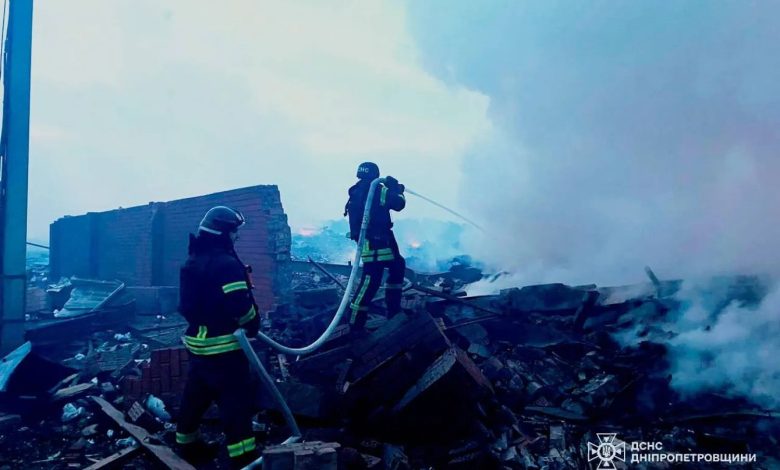
Russian forces struck the city of Dnipro, centred at approximately grid reference 36T VQ 37160 68350 (48.4647°N, 35.0462°E), with missiles in the early hours of 18 May. Dnipropetrovsk Oblast Governor Oleksandr Hanzha, writing on Telegram, reported that Russian forces attacked six districts of the region with missiles, drones, artillery, and aerial bombs. A total of 26 people were wounded, 18 of them in the city of Dnipro itself, including two children: a girl of two and a boy of 10. Four of the wounded required hospitalisation.
A 24-storey residential building in Dnipro took a direct hit, with fires reported burning across the city. In the Dniprovsky district, private houses and cars were damaged and two women were wounded, one of them a 76-year-old who was hospitalised. In the Samarivsky district, a house, an administrative building, and multiple vehicles caught fire. An agricultural company was also damaged. In Kryvyi Rih, part of the broader Dnipropetrovsk Oblast, an enterprise and infrastructure were damaged. Two men aged 36 and 40 were hospitalised in moderate condition.
Ukraine’s Air Force, in a post on Telegram carried by Arab News and Reuters, stated that Russia launched a total of 524 drones and 22 missiles overnight, with the main target being the city of Dnipro and its surrounding region. Air defence units shot down or electronically neutralised 503 drones and four missiles. That leaves 21 drones and 18 missiles that penetrated Ukrainian defences. The drone intercept rate of approximately 96% is consistent with recent performance, but the missile figure tells a harsher story: only four of 22 were stopped, an intercept rate of roughly 18%.
🟡 Odesa, Kherson, Zaporizhzhia
Residential Areas, Schools, and a Kindergarten: Three More Regions Hit
In Odesa, at approximately 36T UP 59280 49970 (46.4825°N, 30.7233°E), Russian drones struck residential buildings in the Black Sea port city. Serhiy Lysak, head of the local military administration, reported on Telegram that the attack also damaged an educational lecture hall and a kindergarten. An 11-year-old boy and a 59-year-old man were wounded. Odesa remains a consistently targeted city in the Russian aerial campaign, with its port infrastructure and energy grid drawing repeated strikes throughout 2026.
In the Kherson region, at approximately 36T VQ 77420 66440 (46.6354°N, 32.6169°E), attacks killed one person and wounded nine. Governor Oleksandr Prokudin confirmed the toll on Telegram. Kherson, de-occupied since November 2022 but within range of Russian forces on the opposite bank of the Dnipro River, faces near-daily shelling. The previous week saw one killed and 31 wounded in a single day of shelling across the region.
In the Zaporizhzhia region, at approximately 36T VQ 43820 41980 (47.8388°N, 35.1396°E), three people were wounded in overnight attacks, Governor Ivan Fedorov said on Telegram. Zaporizhzhia has been among the most heavily targeted frontline cities in 2026, with hundreds of strikes on settlements per day reported by the regional military administration across this month alone.
🔵 The Interception Gap
96% for Drones, 18% for Missiles: Ukraine’s Persistent Air Defence Asymmetry
The night of 18 May produced a dataset that crystallises a structural problem Ukraine has been unable to solve since the full-scale invasion began in February 2022. Of 524 drones launched, Ukraine stopped 503, a rate of approximately 96%. Of 22 missiles, Ukraine stopped four, a rate of approximately 18%. The same asymmetry was visible in the 13 to 14 May mass assault, where President Zelensky reported a 94% interception rate for drones but only 73% for missiles across a two-day window involving 1,567 drones and 56 missiles.
The practical consequence is visible in the casualty pattern. Drones, when intercepted at 96%, produce relatively few ground casualties even at volumes above 500. Missiles, when intercepted at under 20%, reach their targets and kill. The 18 May intercept rate for missiles was lower than the 13 to 14 May figure, which may reflect variations in missile type, launch geometry, or the depletion of interceptor stocks following a week of intense activity. Ukraine’s Air Force has not disclosed what types of missiles Russia used on 18 May, and this report does not speculate beyond noting that Kinzhal, Iskander-M, and Kh-101/Kh-555 variants have all appeared in documented attacks during May 2026.
Zelensky, after the 13 to 14 May barrage, explicitly identified ballistic missiles as the critical gap and ordered his military and intelligence agencies to prepare response options. His commander of the Unmanned Systems Forces addressed Moscow residents directly on Telegram during the 17 May Ukrainian drone strike on the capital, signalling that Ukraine intends to keep the retaliatory pressure on Russian civilian centres. The escalation cycle is now operating on a 24 to 48 hour rotation.
⚠ The Ceasefire Collapse
From 72 Hours of Quiet to 1,567 Drones in Two Days: The Post-Ceasefire Spiral
The Trump-brokered three-day ceasefire of 9 to 11 May, timed to Russia’s Victory Day commemorations, was meant to demonstrate that both sides could pause. It proved the opposite. Both Russia and Ukraine accused each other of violations during the 72-hour window, and when it expired, the escalation resumed at a pace that exceeded pre-ceasefire levels. Russia launched 1,567 drones and 56 missiles in the two-day barrage of 13 to 14 May, the most intense combined aerial attack of the year. In Kyiv, a nine-storey apartment building in the Darnytsia district was completely demolished, killing nine people.
The prisoner-of-war exchange on 15 May, in which each side returned 205 soldiers, was the single visible product of the ceasefire period. Beyond that, the dynamic has been pure escalation. Russia struck nearly 300 drones at Ukraine on 16 May, killing one and wounding 23 in Kherson alone. Ukraine responded on 17 May with more than 500 drones targeting the Moscow region, killing at least three people, causing debris to fall on Sheremetyevo Airport, and prompting the Unmanned Systems Forces commander to address Moscow’s elite residential district by name on Telegram. Russia answered on 18 May with 524 drones and 22 missiles.
The pattern is neither new nor surprising. It mirrors the post-Easter 2026 escalation cycle and the post-energy-truce escalation in February. Each temporary pause is followed by a recalibration upward. What has changed since May is the volume: the numbers of drones deployed in a single night by both sides have crossed the 500 mark with increasing regularity. Russia’s industrial capacity to produce Shahed-type drones, now assembled in facilities inside Russia with components that continue to reach production lines despite Western sanctions, appears to be running at or near peak output.
Oleksandr Hanzha : Governor, Dnipropetrovsk Oblast, 18 May 2026 via Telegram
“Twenty-six people were wounded. The enemy attacked six districts of the region with missiles, drones, artillery and aerial bombs.”
Source Reliability Matrix
NATO grading: REL A (reliable) to F (unreliable). CRED 1 (confirmed) to 6 (cannot judge).
CRED 1
Primary wire. Carried by Arab News, Global Banking and Finance, and multiple aggregators. Reuters notes it could not independently verify battlefield reports.
CRED 2
Official Ukrainian military source for drone and missile counts. Interested party, but figures consistent over time and carried by Reuters.
CRED 2
Established English-language Ukrainian outlet. Developing story, updated continuously.
CRED 1
Ukrainian wire service. Detailed breakdown of Dnipro casualties and damage by district sourced directly from Hanzha’s Telegram.
CRED 2
Established Saudi outlet. Reports 546 drones, diverging from the Air Force’s own 524 figure. Likely an earlier count before the official Air Force tally was finalised.
Strategy Battles Assessment
The ceasefire did not fail; it was never designed to hold. It functioned as a reload window for both sides, and the post-expiry escalation was predictable, predicted, and now underway at volumes that exceed anything seen before May 2026.
✓ What We Know
Russia launched 524 drones and 22 missiles at Ukraine overnight on 18 May, per the Ukrainian Air Force. Ukrainian defences stopped 503 drones and four missiles. One person was killed in Kherson and more than 30 were wounded across Dnipro, Odesa, Kherson, and Zaporizhzhia. Dnipro was the primary target: 26 wounded, a 24-storey building hit. The strike followed by less than 24 hours Ukraine’s largest drone attack on the Moscow region in over a year. Both sides deny targeting civilians. Reuters could not independently verify battlefield reports.
? What We Do Not Know
The missile types used in the 18 May strike. Whether the 18% missile intercept rate reflects interceptor stock depletion after a week of near-daily engagements or a change in Russian missile composition. The exact point of origin for drones launched at Dnipro. Whether the strike on the 24-storey building in Dnipro was a guidance failure or a deliberate targeting decision. Whether the drone count discrepancy between sources (524 vs 546) reflects a preliminary tally error or a methodological difference.
☉ What To Watch
Whether the tit-for-tat cycle breaks above the 500-drone-per-night threshold permanently or reverts to lower volumes. Whether European partners accelerate delivery of Patriot and SAMP/T interceptors in response to the deteriorating missile intercept rate. Whether Russia shifts targeting from Dnipro back to Kyiv or energy infrastructure, which has been a secondary target this week. Whether Trump or any other mediator proposes a second ceasefire attempt, and whether either side signals willingness. Whether the casualty count from the 18 May strike rises as damage assessments continue throughout Monday.
Sources
- More Than 30 Wounded in Russian Attacks on Ukraine Overnight, Asharq Al-Awsat, 18 May 2026
- Russia launched 524 drones, 22 missiles at Ukraine overnight, Ukraine air force says, Arab News / Reuters, 18 May 2026
- Russian drones, missiles strike multiple Ukrainian regions, injuring at least 12, Kyiv Independent, 18 May 2026
- 26 wounded in Dnipro and region in enemy attacks, Interfax-Ukraine, 18 May 2026
- Russia hits Ukraine’s Odesa, Dnipro with drones and missiles overnight, Reuters via GBAF, 18 May 2026
- Ukraine attack largest in over a year on Moscow, CNN, 17 May 2026
- Russia launches nearly 300 drones at Ukraine, Euronews, 16 May 2026
Editorial Verification
The 18 May overnight strike is verified through Reuters wire (carried by Arab News, Global Banking and Finance Review, and multiple aggregators), the Ukrainian Air Force Telegram post (carried by Arab News/Reuters), regional governor Telegram statements from Hanzha (Dnipropetrovsk), Lysak (Odesa), Prokudin (Kherson), and Fedorov (Zaporizhzhia), all carried independently by Kyiv Independent, Interfax-Ukraine, and Reuters. The Hanzha statement is the primary source for the 26-wounded figure in Dnipro and the six-district attack scope, corroborated by Interfax-Ukraine with district-level breakdown. The Asharq Al-Awsat figure of 546 drones diverges from the Ukrainian Air Force’s own 524 figure reported by Arab News/Reuters; this report uses the Air Force primary source and notes the discrepancy. The 13 to 14 May strike data is sourced to Zelensky’s Telegram statement (carried by Kyiv Post) and Ukrainian Air Force reports (carried by NPR). The 17 May Moscow attack is sourced to CNN, Euronews, and TASS via CNN. Casualty figures are drawn from regional governor Telegram statements carried by at least two independent wire or news outlets in each case. Both sides deny targeting civilians; Reuters notes it cannot independently verify battlefield reports.
MGRS datum: WGS84 / UTM Zones: 36T and 37T / Cross-check reference: Dnipro city centre 36T VQ 37160 68350
No satellite imagery has been used in this report. Strike coordinates are approximate, based on city-centre positions, as exact strike-point GPS has not been disclosed by any source.
All claims independently attributed and verified to open sources where possible.
Approved for Publication
Marcus V. Thorne
Lead Editor, Strategy Battles
FILE SB-2026-0518-088801 // CLEARED
©StrategyBattles.net 2026
This article is for news and analysis purposes only. Based on publicly available news sources and military updates. All rights reserved. Not for commercial reuse without permission.