Military Alone Cannot End Hezbollah Threat: Israeli Source to Kan as Ceasefire Extended 45 Days”
Threat Level Assessment
LEVEL 3 OF 5, DEVELOPING
Bottom Line Up Front
An unnamed Israeli security source told public broadcaster Kan, in remarks reported by Daily Beirut on 17 May, that military action alone cannot eliminate the threat from southern Lebanon and that a political breakthrough is now required alongside long-term deterrence. The framing tracks earlier April assessments from the IDF and from Prime Minister Netanyahu that drone and rocket threats cannot be fully neutralised by ground action, and it lands two days after Israel and Lebanon agreed a 45-day extension of the porous April ceasefire. The quote itself is single-source; the underlying analytical line is corroborated across multiple outlets reaching back to early April.
Key Judgments
The Israeli security establishment now publicly accepts that the buffer-zone strategy has a ceiling. The 3 April IDF reframing carried by FDD said disarming Hezbollah militarily was unrealistic because it would require occupying all of Lebanon. Netanyahu on 27 April stated the 122mm rocket and drone threats demand a combination of operational and technological activity, not occupation. The 17 May Kan quote, even single-source, fits a six-week pattern of converging signals from Jerusalem.
The “political breakthrough” framing is a deliberate trial balloon ahead of the next round of Washington talks. The 15 May 45-day ceasefire extension, the establishment of separate military and political negotiating tracks per the Lebanese statement, and Ambassador Yechiel Leiter’s pre-talks language about a peace-treaty track plus a security track all point to Jerusalem preparing the domestic public for a settlement that does not deliver instant Hezbollah disarmament. The Kan-channelled quote softens that landing.
Whether this quietly authorised messaging will translate into Israeli operational restraint in southern Lebanon over the 45-day window. Daily strikes have continued through the existing ceasefire, including ten dead in Lebanon on the day the talks opened. The political-track concession may run in parallel with continued kinetic action, not in place of it; Dichter’s earlier “we are constrained” remarks suggest the constraints are external (Washington) rather than internal.
45
Days, ceasefire extension
2,896
Lebanese killed since 2 Mar
1,200+
IDF raids, southern Lebanon
500K
Shekels per defensive net
📍 Southern Lebanon theatre, IDF buffer zone and key strike points, May 2026

Map showing approximate Blue Line, IDF buffer zone, Litani river, and key reported activity sites 13 to 17 May 2026. Boundaries are illustrative. Datum WGS84, UTM Zone 36S. Map: Strategy Battles / OSINT.
📍 Tyre, IDF Strike Cluster 15 May
MGRS: 36S XA 97170 84720
33.2730°N 35.1930°E
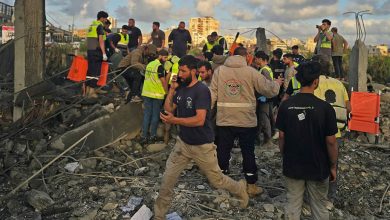
37 wounded per Lebanese Health Ministry, including six hospital personnel, nine women and four children. IDF cited Hezbollah infrastructure.
📍 Bint Jbeil, Main Ground Combat Town
MGRS: 36S YA 19200 65980
33.1220°N 35.4280°E
Principal site of ground combat since 16 March invasion. IDF retains positions inside the village footprint. Symbolic battleground.
📍 Marjeyoun, Shelling 16 to 17 May
MGRS: 36S YB 33700 92500
33.3620°N 35.5910°E
Heavy shelling reported overnight per Daily Beirut. Residents describe panic. Site of long-running IDF artillery activity.
📍 Naqoura, UNIFIL Headquarters
MGRS: 36S XA 92800 65000
33.1150°N 35.1400°E
UN Interim Force in Lebanon HQ. Hit by presumed Hezbollah drones in early May. One drone of Iranian manufacture per UNIFIL.
SITREP Timeline : Lebanon Track, April to May 2026
🔴 The Kan Quote
An Unnamed Security Source, A Public Broadcaster, And A Sentence Jerusalem Wanted On The Record
The Israeli public broadcaster Kan carried remarks on 17 May from an unnamed Israeli security source speaking to the Knesset news network earlier in the week, reported in English by Beirut-based outlet Daily Beirut. The source said that even full Israeli control of southern Lebanon, up to and beyond the Litani river at approximately grid reference 36S YB 28920 06430 (33.4600°N, 35.5300°E), would not allow the destruction of “the last remaining explosive drones or rockets of Hezbollah.” The conclusion drawn in the same set of remarks was that a political breakthrough is needed alongside long-term military deterrence to change the operational reality.
The quote is single-source through Daily Beirut at time of writing. No independent wire pickup of the exact Kan attribution has surfaced in Reuters, AFP, AP, or the Times of Israel liveblogs covering 16 to 17 May. This is the principal verification caveat for the article. The analytical content, however, sits on far firmer ground: it is functionally identical to the IDF’s 3 April reframing reported by FDD, to Netanyahu’s 27 April statement carried by Euronews, and to the consistent line from Israeli Ambassador to Washington Yechiel Leiter, who said before the third round of talks that Israel would pursue a broader political track conditional on Hezbollah being “dismantled.”
Background quotes attributed to anonymous security sources on a public broadcaster are normally not accidents in the Israeli information environment. They serve a domestic-audience function. The conventional reading is that the security establishment, having concluded that ground reoccupation of southern Lebanon has a strategic ceiling, is using Kan and the Knesset news platform to begin preparing the Israeli public for a settlement that does not deliver immediate, comprehensive disarmament of Hezbollah. The 45-day ceasefire extension agreed on 15 May, the Lebanese statement establishing separate military and political tracks, and now the Kan placement on 17 May, all read as parts of one sequence.
🟡 The Strategic Ceiling
Why The Litani Is Not The Answer To Drones Fired From High Elevations
The structural argument in the Kan source’s framing is one that has been openly canvassed in Israeli defence reporting since at least mid-April. Hezbollah’s most operationally awkward weapons for the IDF are first-person view drones and fiber-optic guided drones, which are cheap, mass-produced, immune to most electromagnetic countermeasures, and launched from high ground that does not need to be inside any particular line on a map. The IDF in southern Lebanon, however far it advances, cannot occupy every ridge from which a drone can be flown. Times of Israel reporting from early May described Israeli troops as “hunted” by the systems and Israel’s overall Lebanon strategy as “at risk” if no answer is found.
122mm rockets, the second threat Netanyahu named on 27 April, sit in the same category. Their range, their dispersal across Hezbollah’s depth, and the relative ease of replacement mean they cannot be eliminated by any volume of strikes that Israel is presently willing to absorb diplomatically. Daily Beirut’s source line on protective nets at half a million shekels each is a footnote, but a telling one: the IDF is hardening its targets, not removing the threat. The buffer zone at Bint Jbeil (36S YA 19200 65980, 33.1220°N, 35.4280°E) and the Yellow Line further north stop infantry, not airborne munitions.
The same security source line was reinforced two weeks earlier, in different framing, by Agriculture Minister Avi Dichter of the security cabinet. Speaking to Israel’s Oko and Atali on a Wednesday, Dichter said Israel is “constrained in Lebanon because of our American partner” and that Washington has linked the Lebanese file to the Iranian file. That is a different sentence about a different constraint, but it points to the same conclusion: the freedom of action that would be required to eliminate the threat on the ground is not available, by Jerusalem’s own admission.
Unnamed Israeli security source to Kan, per Daily Beirut, 17 May 2026 : single-source attribution
“Even if we take full control of all of southern Lebanon, as some propose, these steps will not allow us to destroy the last remaining explosive drones or rockets of Hezbollah.”
🔵 The Washington Track
A 45-Day Extension, Two Tracks, And A Negotiation That Israel Has Already Conceded Cannot Be Settled By Force
The third round of direct Lebanon-Israel talks at the State Department on 15 May produced a 45-day ceasefire extension, announced by US State Department spokesperson Tommy Pigott. It was the second extension since the original 17 April truce. Lebanon’s statement in the wake of the talks made specific reference to the establishment of separate military and political tracks, and Lebanese envoy Simon Karam led the delegation against Israeli Deputy National Security Adviser Yossi Draznin on the other side. President Trump and President Aoun had spoken before the talks; Aoun declined a face-to-face meeting with Netanyahu, telling Trump that a public handshake followed by collapse of the talks would have severe internal repercussions inside Lebanon.
The split between Israeli and Lebanese opening demands has not closed. Israeli Ambassador Yechiel Leiter told Walla before the third round that Israel “will never agree to a ceasefire in Lebanon while allowing Hezbollah to rearm.” The Lebanese delegation, per a senior official quoted by AP, wants a complete ceasefire and an Israeli withdrawal first, with the question of Hezbollah’s weapons handled politically inside Lebanon thereafter. Hezbollah secretary-general Naim Qassem has called direct negotiations with Israel a “grave sin”; Hezbollah MP Ihab Hamadeh has vowed the group will “thwart” the talks. Yet the talks continue, the extension was granted, and Israel allowed the announcement.
What is striking, in this context, is that the Kan-channelled security source’s framing aligns with the Lebanese opening position, not the Israeli one. The Lebanese demand that the weapons file be handled “politically” is precisely what the source has now been quoted endorsing in principle. The strategic distance between Jerusalem’s public posture, which insists on dismantlement before any peace track, and Jerusalem’s private working assumption, which appears increasingly to accept that the dismantlement piece can only ever be partial and gradual, is the entire negotiation. The 17 May Kan placement makes that distance fractionally smaller.
⚠ What This Quote Is Not
A Single Background Source Is Not A Policy Shift; The Ground War Continues Daily
An anonymous security source speaking to a national broadcaster is a signal, not a directive. The Israeli ground war in southern Lebanon has continued through every previous extension of the ceasefire, including on 15 May itself, when strikes on the Tyre district (36S XA 97170 84720, 33.2730°N, 35.1930°E) wounded 37 people during the second day of the Washington talks. In the 48 hours before this article was written, Daily Beirut and other Lebanese outlets reported heavy shelling at Marjeyoun (36S YB 33700 92500, 33.3620°N, 35.5910°E) and Israeli operations against approximately 100 Hezbollah sites. The IDF on 17 May said Hezbollah had fired rockets and explosive drones at troops overnight with no injuries.
Lebanese Health Ministry figures put the death toll since 2 March at 2,896 with 8,824 wounded, of which around 400 have been killed since the nominal ceasefire began. The Israeli toll inside Lebanon stands at 18 soldiers, plus two civilians inside Israel and a defence contractor. Six United Nations peacekeepers have been killed since hostilities resumed. These are not the casualty patterns of a war that has tactically ended. They are the casualty patterns of a war that is being publicly bracketed by a ceasefire while its central operations continue.
The structural issue Lebanon faces in any political track is the same one analyst Joe Macaron set out for The New Arab before the third round of talks: the Lebanese government does not hold the security file in southern Lebanon. Without Hezbollah’s consent, no agreement signed in Washington can be implemented on the ground. The Israeli political-track concession signalled by the Kan source moves Jerusalem closer to the Lebanese position only in framing, not in substance. The substance is unchanged: Israel wants Hezbollah’s arsenal gone before any peace, and Hezbollah will not surrender it under duress.
Source Reliability Matrix
NATO grading: REL A (reliable) to F (unreliable). CRED 1 (confirmed) to 6 (cannot judge).
CRED 2
Beirut-based outlet, reporting Kan attribution second-hand
CRED 3
Anonymous security source via national broadcaster; cannot be independently judged
CRED 1
Established outlet, ceasefire extension and operational details confirmed
CRED 1
Wire coverage of the third round of Washington talks
CRED 2
Named senior Israeli officials on the record, but each statement from one outlet
CRED 2
Policy-aligned think tank, IDF reframing analysis substantively reliable
CRED 2
Lebanese-perspective outlet, useful for analyst quotes and counter-framing
Strategy Battles Assessment
Jerusalem has begun, quietly, to admit in public what the IDF has been saying in private since 3 April: there is no military path to a clean end-state in southern Lebanon. The Kan placement is a domestic-audience preparation for a negotiated outcome that will fall short of total Hezbollah disarmament.
✓ What We Know
A 45-day ceasefire extension was announced by the US State Department on 15 May. Daily Beirut on 17 May carried a Kan-attributed quote from an unnamed Israeli security source stating that military action alone cannot eliminate the Hezbollah threat from southern Lebanon. The IDF’s 3 April reframing, Netanyahu’s 27 April statement, and Dichter’s “constrained” remarks all sit on the same analytical line. Strikes have continued daily through every ceasefire phase, with 2,896 Lebanese killed since 2 March.
? What We Do Not Know
The exact identity of the Kan source or the exact day of the Knesset news network interview, beyond Daily Beirut’s “Wednesday morning” reference. Whether the placement was cleared through the Prime Minister’s Office or whether it represents an internal security-cabinet faction trial-balloon over the cabinet’s head. Whether the 45-day extension is intended to expire into a fourth round of talks or into a wider regional framework. Whether the political-track concession will be matched by operational pause or run in parallel with continued kinetic activity.
☉ What To Watch
The cadence of Israeli strikes inside the 45-day extension window. Whether named Israeli officials echo the Kan framing on the record over the next two weeks. Whether the Israeli ambassador’s pre-talks language about a peace-treaty track survives into the fourth round. Whether Hezbollah secretary-general Naim Qassem’s “grave sin” line shifts. Whether Lebanon’s parliament speaker Nabih Berri, who has signalled willingness to handle the weapons file, is given the political space to do so. Whether Aoun agrees to direct contact with Netanyahu, which he has so far declined.
Strategy Battles Related Coverage
Sources
- Israel sees need for political breakthrough in Lebanon, Daily Beirut, 17 May 2026
- May 15 liveblog (ceasefire extension, Tyre strikes), Times of Israel, 15 May 2026
- May 17 liveblog (Hezbollah rocket and drone fire), Times of Israel, 17 May 2026
- Lebanon and Israel kick off new negotiations, PBS NewsHour / AP, 15 May 2026
- New round of Lebanon-Israel talks kicks off, NBC News, 15 May 2026
- Military action still needed to counter Hezbollah rockets and drones, Euronews, 27 April 2026
- Israeli goals in Lebanon war shift from imminently disarming Hezbollah, FDD Long War Journal, 3 April 2026
- “We are constrained”: Cabinet member contradicts Netanyahu on Lebanon, Jerusalem Post, late April 2026
- Hunted by drones it should have seen coming, Times of Israel, early May 2026
- Lebanon and Israel enter talks with little common ground, The New Arab, 15 May 2026
- 2026 Lebanon war, Wikipedia (background)
- 2026 Israel-Lebanon peace talks, Wikipedia (background)
Editorial Verification
The specific Kan-attributed quote from an unnamed Israeli security source (the “Even if we take full control” passage and the “political breakthrough is required” line) is single-source through Daily Beirut at time of writing. No independent wire pickup of the exact Kan attribution has been located in Reuters, AFP, AP, Times of Israel, or other Israeli or international wire outlets covering 15 to 17 May 2026. This caveat is flagged on the dossier header with a purple tag and noted in the body. The underlying analytical content of the source’s remarks is independently corroborated by named on-the-record statements from Prime Minister Netanyahu (Euronews, 27 April), the IDF’s 3 April reframing (FDD), Agriculture Minister Avi Dichter (Jerusalem Post), and Israeli Ambassador to Washington Yechiel Leiter (cited by The New Arab and Walla). The 15 May ceasefire extension, the third round of Washington talks, and the Tyre district casualty figures are confirmed by Times of Israel liveblog, NBC News, PBS NewsHour, and AP wire copy. Casualty figures (2,896 Lebanese, 8,824 wounded) are from Lebanese Health Ministry as reported by NBC News and PBS NewsHour. No satellite imagery was used in this report. Coordinate cards are approximate, illustrative reference points; the Tyre, Bint Jbeil, Naqoura, and Marjeyoun MGRS values are placed at representative town centres, not at specific named strike sites.
MGRS datum: WGS84 / UTM Zone: 36S / Cross-check reference: Tyre town centre 36S XA 97170 84720
No satellite imagery has been used in this report.
All claims independently attributed and verified to open sources where possible.
Approved for Publication
Marcus V. Thorne
Lead Editor, Strategy Battles
FILE SB-2026-0517-04785501 // CLEARED
©StrategyBattles.net 2026
This article is for news and analysis purposes only. Based on publicly available news sources and military updates. All rights reserved. Not for commercial reuse without permission.