UAE Barakah Nuclear Plant Hit by Drone Generator Fire, No Radiation, IAEA Voices Grave Concern
Threat Level Assessment
LEVEL 4 OF 5, SERIOUS
Bottom Line Up Front
Three drones crossed the UAE’s western border on Sunday morning 17 May. UAE air defences intercepted two; one struck an electrical generator just outside the inner perimeter of the Barakah Nuclear Energy Plant, the first nuclear power station in the Arab world. There were no injuries and radiological safety levels were unchanged. Emergency diesel generators are now powering Unit 3. The UAE Foreign Ministry called the incident a “treacherous terrorist attack” and the IAEA voiced “grave concern”. Attribution remains under investigation; the UAE has stated only that the launch axis was the western border, not Iran’s eastern flank.
Key Judgments
The incident is a strategic escalation regardless of attribution. The Barakah plant is the only nuclear facility on the Arabian Peninsula and is the political centrepiece of UAE energy policy; targeting its perimeter crosses a threshold that previous strikes on oil and airport infrastructure did not. The IAEA’s same-day formal expression of “grave concern” and the Director General’s direct phone call with the UAE Foreign Minister confirm the international read.
The launch geometry points to an Iran-aligned actor rather than to Iran directly. The UAE Ministry of Defence specified that the drones entered from the western border, which is the Saudi frontier, not the eastern coast facing the Iranian mainland. Previous Iranian salvoes on the UAE since 28 February have followed an east-to-west trajectory across the Gulf. A western approach is consistent with Houthi launches out of northern Yemen tracking up the Saudi coast, or with Iraqi Shi’ite militia UAVs routed via the southern Saudi desert.
Damage was confined to the auxiliary side of the plant and reactor safety was never at risk, but this should not be read as proof of restraint by the attacker. The strike point was an outdoor electrical generator at the perimeter; the inner reactor envelope is hardened, monitored, and surrounded by exclusion fencing. A drone that penetrated UAE air defence over 200 kilometres of internal airspace had the opportunity to test the perimeter, and the outcome reflects what was reachable on the day rather than a calibrated decision to spare the reactors.
Whether the strike was authorised by Tehran as a deliberate signalling event during the stalled US-Iran negotiations, or whether it was an opportunistic action by an aligned non-state actor exploiting the broken ceasefire to embarrass the UAE for its role hosting US forces. Both readings are operationally compatible with the launch axis and the target choice; only forensic recovery of the drone wreckage and an official UAE attribution will resolve it.
3
Drones, 17 May
2
UAVs Intercepted
5.6 GW
Plant Capacity
0
Casualties, Radiation Impact
📍 UAE Western Approach, Barakah NPP, Al Dhafra, 17 May 2026

Approach geometry, schematic. Datum WGS84, UTM Zones 39Q, 39R and 40R. Map: Strategy Battles / OSINT.
📍 BARAKAH NUCLEAR ENERGY PLANT
MGRS: 39Q XG 23105 51433
23.9700°N 52.2100°E
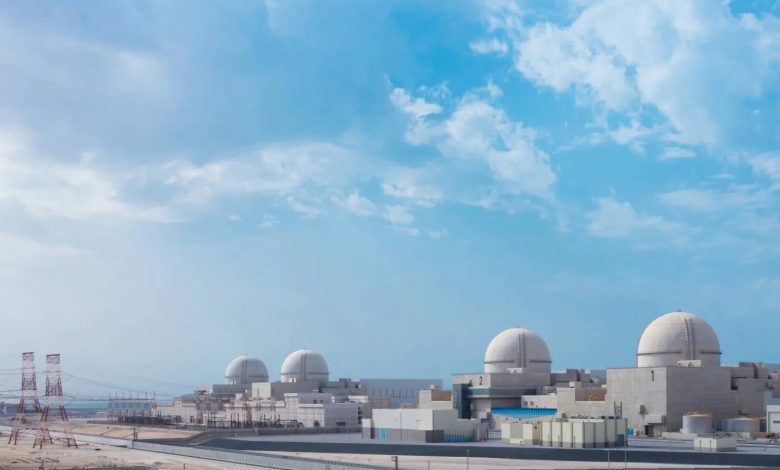
Strike point. Electrical generator outside the inner perimeter. Four APR1400 reactors, 5.6 GW total. Fire contained without injuries. Emergency diesel generators powering Unit 3 per IAEA.
📍 RUWAIS (AL DHANNAH), CROSS-CHECK
MGRS: 39R XG 75841 66382
24.1000°N 52.7300°E
Industrial city and oil hub. Barakah lies approximately 53 km west-southwest of Ruwais per the UAE government and ENEC site description. Used as the grid-orientation reference for this report.
📍 ABU DHABI CITY
MGRS: 40R BN 35404 06544
24.4500°N 54.3900°E
UAE capital. Approximately 225 km east of the Barakah plant per Associated Press. Houses the Defence Ministry that issued the western-border attribution statement.
📍 GHUWAIFAT, UAE/SAUDI FRONTIER
MGRS: 39R WG 55941 54335
24.0000°N 51.5500°E
Western border reference point. Closest UAE/Saudi crossing to the plant. The Defence Ministry’s “western border” framing places the inbound axis through this sector rather than across the Strait of Hormuz.
SITREP Timeline : UAE Under Iranian Strike Campaign, Feb to May 2026
🔴 The Strike
A Drone, A Generator, And A Plant That Powers A Quarter Of The UAE
The Barakah Nuclear Energy Plant sits on the Persian Gulf coast at approximately grid reference 39Q XG 23105 51433 (23.9700°N, 52.2100°E), roughly 53 km west-southwest of the city of Ruwais in Abu Dhabi’s Al Dhafra Region. Built by a South Korean-led consortium for the Emirates Nuclear Energy Corporation at a programme cost of around 20 billion US dollars, it is the first commercial nuclear power station in the Arab world. Its four APR1400 reactors deliver 5.6 GW of installed capacity and approximately 40 TWh annually, which is around a quarter of the UAE’s total electricity demand. Carbon emissions avoided by Barakah operations are reported by ENEC at 22.4 million tonnes a year.
On Sunday morning, an electrical generator sitting outside the plant’s inner perimeter caught fire. The Abu Dhabi Media Office attributed the cause to a drone strike. The UAE Federal Authority for Nuclear Regulation confirmed in a public statement that “the safety of the power plant or the readiness of its essential systems was not affected, and all units at the Barakah facility are operating normally.” Emergency response teams contained and extinguished the fire. No injuries were reported and radiological safety levels remained unchanged. The IAEA, in a post on its official X account, separately confirmed that emergency diesel generators were powering Unit 3 in the aftermath.
The UAE Ministry of Defence, in a Sunday statement, said three drones entered UAE airspace from the western border. Two were successfully engaged by air defences. The third penetrated to Barakah. The ministry stated that investigations were under way to determine the source and that further details would be released on conclusion. The armed forces, the statement added, remained “fully prepared to confront any potential threats” and would respond firmly to anything undermining national sovereignty and the country’s strategic interests.
⚠ The Attribution Question
A Western Border Means Saudi Arabia, Which Means The Answer Is Not Simply Iran
The UAE’s choice of words on the launch geometry matters. The ministry did not say the drones came from Iran. It said they crossed the western border. That border, in the Al Dhafra context, is the frontier with Saudi Arabia at sectors such as Ghuwaifat at approximately 39R WG 55941 54335 (24.0000°N, 51.5500°E). Since 28 February, the bulk of Iranian salvoes against the UAE has come east-to-west across the Persian Gulf or down the Strait of Hormuz, hitting targets in Fujairah, Dubai, and Abu Dhabi from the seaward side. A western approach is structurally different.
Three possibilities sit on the table. The first is a Houthi long-range UAV out of northern Yemen tracking along the Saudi-Yemeni axis before turning east. The Houthi movement publicly claimed to have fired a cruise missile at Barakah while the plant was under construction in December 2017, a claim which the UAE rejected at the time. The plant has not since been touched. The second is an Iraqi Shi’ite militia drone of the type that has been launching against Iranian Kurdish opposition sites in the Kurdistan Region of Iraq, routed across the Saudi desert and into the UAE from the north-west. The third is an IRGC asset deliberately staged through a non-Iranian launch axis to obscure attribution. All three involve Iran as the strategic principal in some form; only the first two avoid direct state responsibility for Tehran.
The UAE has, in keeping with its standing practice, not publicly named a source. The Defence Ministry’s emphasis on a continuing investigation suggests Abu Dhabi prefers to wait until forensic evidence from the drone wreckage and the air-defence track data narrows the field. That hesitation is also diplomatic. A direct attribution to Iran during a stalled US-Iran negotiation would force a Gulf Cooperation Council response posture that the UAE may not be ready to commit to. An attribution to the Houthis would reopen a file that Abu Dhabi closed in 2022. An attribution to an Iraqi militia would put pressure on Baghdad that the UAE has been careful to apply only through quieter channels.
Rafael Grossi : IAEA Director General, Official X Statement, 17 May 2026
“The IAEA has been informed by the UAE that radiation levels at the Barakah nuclear power plant remain normal and no injuries were reported after a drone strike this morning caused a fire in an electrical generator located outside the inner site perimeter of the nuclear power plant. Emergency diesel generators are currently providing power to the nuclear power plant’s Unit 3. Military activity that threatens nuclear safety is unacceptable.”
🔵 The Regulator And The Watchdog
FANR Confirms Reactor Safety, Grossi Phones Abu Dhabi, Diesel Generators Pick Up Unit 3
The Federal Authority for Nuclear Regulation is the UAE’s independent civilian nuclear regulator, operating under the framework of the country’s 2009 “123 Agreement” with the United States that bars domestic uranium enrichment and reprocessing of spent fuel. FANR confirmed within hours of the strike that the safety of the plant and the readiness of its core systems were not affected and that all four units were operating normally. The reference position is structural: Barakah’s APR1400 reactors sit inside hardened containment buildings and rely on multiple redundant power sources, of which the strike-affected generator was only one component on the auxiliary side of the site. The plant’s grid lies at approximately 39Q XG 23105 51433 (23.9700°N, 52.2100°E).
The detail in the IAEA statement that “emergency diesel generators are currently providing power to the nuclear power plant’s Unit 3” is the most operationally significant disclosure of the day. It indicates that the affected generator was part of the auxiliary power supply chain for Unit 3 specifically, and that the loss was sufficient to trigger a transfer to emergency diesel backup. That is the system working as designed. It is also a reminder that future strikes which displaced more of the auxiliary power chain could begin to test the redundancy depth. IAEA Director General Rafael Grossi spoke by phone on Sunday with Sheikh Abdullah bin Zayed, the UAE Deputy Prime Minister and Foreign Minister, reiterating the call for maximum military restraint near nuclear power plants.
UAE Ministry of Foreign Affairs Statement, 17 May 2026
“The incident constitutes a dangerous escalation, an unacceptable act of aggression, and a direct threat to the country’s security.”
🟡 The Ceasefire Context
A Truce That Has Survived Six Weeks Of Targeted Strikes And One Hit On A Nuclear Plant
The 8 April Pakistan-mediated US-Iran ceasefire ended six weeks of open hostilities between Washington and Tehran. It did not end them between Tehran and the Gulf monarchies. The UAE saw the resumption of strikes on 4 May with an Iranian missile and drone salvo that ignited a fire at the Fujairah Petroleum Industries Zone and injured three Indian nationals. A further round on 10 May saw two drones engaged over UAE airspace alongside reported incidents in Kuwait and Qatar. The Iranian parliament’s national security commission spokesman declared on the same day that “Our restraint is over as of today,” language that, by 17 May, has been borne out at Barakah.
For Washington, the immediate problem is whether a hit on a nuclear plant constitutes a ceasefire breach material enough to require an enforcement action. The Trump administration’s pattern in May has been to absorb individual strikes and respond with naval pressure in the Strait of Hormuz rather than with retaliation against Iranian territory. President Trump warned on Sunday that “there won’t be anything left of Iran” unless Tehran agrees to a deal, but the language has been used before and has not yet produced kinetic action since the ceasefire. The Barakah strike will test whether nuclear infrastructure constitutes a different category of red line.
For the UAE, the calculation is internal. Abu Dhabi has, throughout the war, declined to host strikes against Iran from its own soil, even as Iran has accused it of complicity in the US-Israeli campaign against the Islamic Republic. The Barakah hit is the most direct test yet of that posture. The strategic logic of restraint depends on attacks being absorbable; a nuclear plant strike is qualitatively different, and the Foreign Ministry’s “treacherous terrorist attack” framing signals that the threshold has shifted.
Source Reliability Matrix
NATO grading: REL A (reliable) to F (unreliable). CRED 1 (confirmed) to 6 (cannot judge).
CRED 1
Government primary source for the incident and emergency response
CRED 1
Independent civilian nuclear regulator, primary source on reactor status
CRED 2
Government primary source for drone count, intercepts, and western-border framing. Attribution withheld pending investigation.
CRED 1
International nuclear watchdog, official X account, cross-referenced by The National and Khaleej Times
CRED 2
Established wire agencies, carried by CBC and KSAT
CRED 2
Regional news outlets carrying official UAE statements and Foreign Ministry condemnation
CRED 2
Independent international outlets providing corroborating coverage
Strategy Battles Assessment
The Barakah strike is a category change. For the first time in the 2026 war, an Iran-aligned UAV has reached the perimeter of a nuclear power plant in the Arab world. The reactor envelope held; the political and regulatory thresholds did not.
✓ What We Know
Three drones crossed the UAE’s western border on Sunday morning 17 May. Two were intercepted by UAE air defences. One struck an electrical generator outside the inner perimeter of the Barakah Nuclear Energy Plant in Al Dhafra at approximately 39Q XG 23105 51433. No injuries, no radiation impact, all four reactor units operating normally. Emergency diesel generators currently powering Unit 3. UAE has launched an investigation and condemned the incident as a “treacherous terrorist attack” without naming a source. IAEA Director General Grossi expressed “grave concern” and called the UAE Foreign Minister directly.
? What We Do Not Know
Who launched the drones. The UAE has publicly named neither Iran, the Houthi movement, nor any Iraqi militia, deferring to the ongoing investigation. The drone make and model. The exact launch point and routing. Whether the strike was a deliberate signalling event or an opportunistic action by a non-state actor exploiting the broken ceasefire. Whether Tehran will issue a denial of involvement as it did on 10 May, and whether such a denial would be credible. What specific Unit 3 auxiliary equipment was lost beyond the generator itself.
☉ What To Watch
Whether the UAE’s pending attribution names a state or a non-state actor, and whether Abu Dhabi requests US air-defence reinforcement at Barakah. Whether the IAEA Board of Governors convenes an emergency session on military activity near nuclear plants. Whether Saudi Arabia issues a statement on the western-border launch axis, given that it implicates either lax air-space management or hostile activity in Saudi territory. Whether US forces in the region adjust posture given the proximity to the strike to Al Dhafra Air Base. Whether the next strike escalates from auxiliary infrastructure to reactor-cooling or grid-connection assets, the loss of which would test redundancy depth.
Sources
- UAE: Fire at Power Generator Near Barakah Power Plant After Drone Attack, Asharq Al Awsat, 17 May 2026
- Drone strike sparks fire on perimeter of UAE’s Barakah nuclear power plant, Al Jazeera, 17 May 2026
- Drone strike causes fire at Barakah nuclear plant perimeter in Abu Dhabi, The National, 17 May 2026
- UAE investigates source of drones after ‘treacherous terrorist attack’ on Barakah plant, The National, 17 May 2026
- No radiation leak: UAE investigates drone source after Barakah nuclear plant attack, Khaleej Times, 17 May 2026
- U.A.E. reports drone strike at nuclear power plant as Iran war deadlock endures, Reuters via CBC News, 17 May 2026
- A drone strike causes fire outside a nuclear power plant in Abu Dhabi, Associated Press via KSAT, 17 May 2026
- Nuclear power plant set on fire in drone attack, UAE, Newsweek, 17 May 2026
- Drone causes fire at UAE’s Barakah nuclear plant following failed interception, Jerusalem Post, 17 May 2026
- IAEA expresses ‘grave concern’ over drone strike near UAE nuclear plant that triggered a fire, Times of Israel, 17 May 2026
Editorial Verification
The strike, no casualties, and no radiation impact are verified by primary-source UAE government statements from the Abu Dhabi Media Office and the Federal Authority for Nuclear Regulation, corroborated by the IAEA’s official X account. The drone count of three, with two intercepted and one impacting the generator, is verified by the UAE Ministry of Defence statement, corroborated by Reuters, AP, Al Jazeera, The National, Khaleej Times, and Asharq Al Awsat. The IAEA Director General’s statement on “grave concern” and the Unit 3 emergency diesel generator detail is verified through the IAEA X account and corroborated by The National and Khaleej Times. Sheikh Abdullah bin Zayed’s “treacherous terrorist attack” framing is verified through The National and corroborated by Jerusalem Post. Attribution remains officially open at time of writing; the UAE has not publicly named a source. The “western border” framing is a direct UAE Ministry of Defence quotation; the implication that this places the launch axis through the Saudi frontier rather than across the Gulf is original Strategy Battles analysis and is flagged accordingly. The Houthi 2017 claim against Barakah while under construction, denied by the UAE at the time, is verified through Associated Press and Wikipedia. Plant coordinates are taken from the well-published Barakah site location on the Persian Gulf coast; the strike point is reported as the outer perimeter of the plant area, exact GPS for the affected generator is not in public reporting.
MGRS datum: WGS84 / UTM Zones: 39Q (Barakah) / 39R (Ruwais, Ghuwaifat) / 40R (Abu Dhabi) / Cross-check reference: Ruwais (Al Dhannah) 39R XG 75841 66382, located approximately 53 km east-northeast of the plant per ENEC and UAE government sources
No satellite imagery has been used in this report.
All claims independently attributed and verified to open sources where possible.
Approved for Publication
Marcus V. Thorne
Lead Editor, Strategy Battles
FILE SB-2026-0517-0546546501 // CLEARED
©StrategyBattles.net 2026
This article is for news and analysis purposes only. Based on publicly available news sources and military updates. All rights reserved. Not for commercial reuse without permission.