UK APKWS Drone-Killer Typhoons Now Operational in Middle East
Threat Level Assessment
LEVEL 3 OF 5, DEVELOPING
Bottom Line Up Front
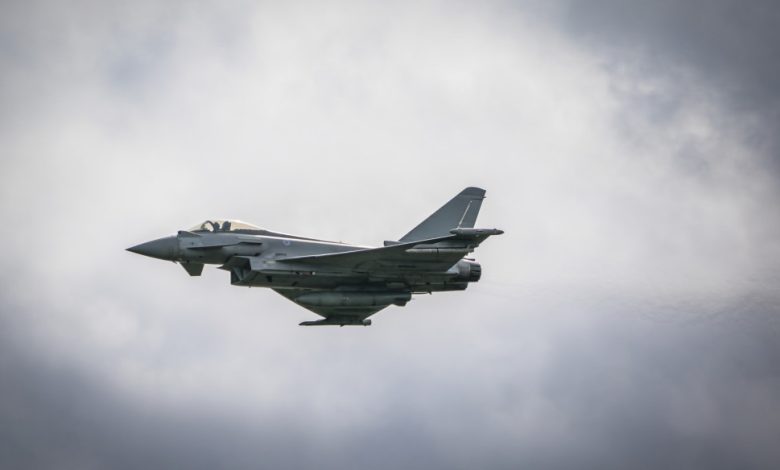
The UK Ministry of Defence on 17 May confirmed that the Advanced Precision Kill Weapon System, a roughly $20,000 laser-guided 70mm rocket conversion, is now in operational service on 9 Squadron RAF Typhoons flying counter-drone sorties from RAF Akrotiri in Cyprus and across the wider Middle East. The system completed ground test firings in March and air-to-air firings with 41 Test and Evaluation Squadron in April, going from trials to fielded weapon in under two months. The APKWS deployment slots into a UK regional footprint that has been thickening since the war opened on 28 February: Sky Sabre on the ground in Saudi Arabia, the Lightweight Multirole Launcher in Bahrain, Rapid Sentry and the RAF’s ORCUS counter-drone system in Kuwait, the joint UK-Qatar Typhoon squadron at Dukhan, and HMS Dragon now forward-deployed for the £115 million Anglo-French Strait of Hormuz mission announced 12 May. London’s framing remains strictly defensive. The hardware story tells a more deliberate posture.
Key Judgments
APKWS on Typhoon is a cost-curve weapon, not a capability leap. Conventional Typhoon air-to-air rounds run from about $400,000 for ASRAAM upwards. APKWS, at roughly $20,000 per round per The National, lets the RAF engage Shahed-class one-way attack drones at something close to munition parity rather than at a 20-to-1 economic loss. The UK is solving an attrition arithmetic problem that Saudi Arabia and the United States have been losing since 2019.
The UK has the largest layered Western air-defence footprint in the Gulf outside US CENTCOM. Sky Sabre in Saudi Arabia, LMM in Bahrain, Rapid Sentry and ORCUS in Kuwait, Typhoon detachments at Dukhan and across Cyprus, Jordan, the UAE and Bahrain, plus HMS Dragon’s Sea Viper system afloat. The MoD’s own running tally exceeds 2,500 flying hours in theatre since the war opened. This is not surge deployment language; this is a sustained second-front commitment.
The Strait of Hormuz mission will not become operational on the original timeline. The MoD’s own language, “when conditions allow”, is doing heavy lifting. With Trump rejecting Tehran’s latest peace proposal on 11 May and the ceasefire visibly fraying, the 40-nation coalition is being assembled before the political conditions for transit-protection operations exist. HMS Dragon’s posture is presence, not opening minesweeping in contested waters.
Whether the UK’s defensive framing survives a single offensive event. London has publicly ruled out ground troops and offensive action since day one. An Iranian strike that kills British personnel at any of the disclosed nodes, or a Houthi-class attack on HMS Dragon, would test that framing against domestic political pressure. The current posture is built on the assumption that nothing exposed actually gets hit.
~$20K
Per APKWS Round
<2 mo
Trials to Operational
£115m
Hormuz Mission Fund
2,500+
UK Flying Hours, Theatre
📍 UK Gulf Military Footprint, May 2026

UK Gulf footprint with operational nodes for APKWS-equipped Typhoons, ground-based air defences, and the HMS Dragon AOR. Datum WGS84, UTM Zones 36S, 37Q, 38R, 39R, 39S, 40R. Map: Strategy Battles / OSINT.
📍 RAF Akrotiri, Cyprus
MGRS: 36S WD 53160 18430
34.5904°N 32.9866°E
9 Squadron RAF Typhoon operating base for APKWS-equipped counter-drone sorties across the wider Middle East.
📍 Dukhan Air Base, Qatar
MGRS: 39R VK 78720 13230
25.4258°N 50.7872°E
Home of the joint UK-Qatar Typhoon squadron. Deployment extended at end of March; flying since day one of conflict.
📍 Sky Sabre, Saudi Arabia
MGRS: 37Q EA 23420 76960
21.4858°N 40.4083°E
Approximate location, King Fahd Air Base, Taif. Sky Sabre battery deployed end-March 2026 per Janes OSINT identification.
📍 LMM Site, Bahrain
MGRS: 39R VL 55300 84320
26.0667°N 50.5500°E
Approximate point, NSA Bahrain area. Thales-built Lightweight Multirole Launcher integrated into Bahraini air defences.
📍 Rapid Sentry / ORCUS, Kuwait
MGRS: 38R PQ 98390 51230
29.3759°N 47.9783°E
Approximate point. Rapid Sentry short-range ground-based system plus RAF ORCUS counter-drone radar operational since late March.
📍 HMS Dragon AOR
MGRS: 40R CN 98850 21660
26.4000°N 56.0000°E
Indicative AOR, Strait of Hormuz approaches. Type 45 destroyer left UK in March, forward-deploying for the multinational mission.
SITREP Timeline : UK Gulf Posture, Mar to May 2026
🔴 APKWS On Typhoon
A $20,000 Drone Killer Reaches Akrotiri In Under Two Months
The headline weapon, confirmed by the UK Ministry of Defence on 17 May, is the Advanced Precision Kill Weapon System. APKWS is a guidance kit that converts the unguided 70mm Hydra rocket, the venerable Cold War-vintage air-to-ground submunition, into a semi-active laser-homing precision weapon. The cost per round is reported by The National at approximately $20,000. That number is the entire commercial argument. The hostile drone profile the UK is now most concerned with intercepting is the Iranian Shahed-136 one-way attack drone, which by US Department of Defense and industry estimates costs Iran somewhere between $20,000 and $50,000 per airframe. APKWS engages that target class at rough munition parity rather than at the order-of-magnitude loss that an ASRAAM or AIM-120 engagement represents.
9 Squadron RAF Typhoon jets are now flying operational counter-drone sorties with the system, from RAF Akrotiri at grid reference 36S WD 53160 18430 (34.5904°N, 32.9866°E) and across the wider Middle East. The Aviationist, citing imagery released by the UK MoD and reporting from Janes correspondent Gareth Jennings, identified the operating base as Akrotiri. 41 Test and Evaluation Squadron carried out the air-to-air firing trials in April, after a ground-target test firing in March. The transition from a successful trial to a fielded combat weapon in under two months is unusual; it reflects the regulatory burden APKWS does not face. The system is already in US service, already certified, and was integrated through what BAE Systems and the MoD described as a rapid procurement effort with industry partners BAE and QinetiQ.
Luke Pollard, the UK Minister for Defence Readiness and Industry, framed the deployment as a cost-effectiveness story. The New Arab’s version of the announcement misstates Pollard’s title as Minister for Defence Procurement and Industry; the correct title per UK MoD is Defence Readiness and Industry. The substance, however, is consistent across the British press, the MoD release, BAE communications, and overseas wire pickup: a faster, cheaper, sustainable answer to a saturation-drone problem that conventional Western air-defence stocks were not designed to absorb. APKWS does not replace ASRAAM or Meteor on the Typhoon’s combat loadout. It adds a low-rung option for the rung of the threat ladder that has dominated the post-28 February air-defence picture in the Gulf.
🟡 The Layered Ground Defences
Sky Sabre In Saudi, LMM In Bahrain, Rapid Sentry And ORCUS In Kuwait
The APKWS announcement reads cleanly only when it is set against the ground-based layer the UK has been quietly assembling since end-March. On 31 March, on a Gulf tour that took him through Riyadh, Doha and Manama, Healey confirmed the deployment of a Sky Sabre battery to Saudi Arabia. Janes subsequently identified the operating site as King Fahd Air Base in Taif, at approximately 37Q EA 23420 76960 (21.4858°N, 40.4083°E). The system is built around a Saab Giraffe radar reaching 120 kilometres at 360 degrees, with Land Ceptor launchers capable of tracking 24 targets simultaneously. A Royal Artillery battery operates it under British command authority, integrated into wider Saudi and regional air-defence networks but not subordinated to them.
In Bahrain, at approximately 39R VL 55300 84320 (26.0667°N, 50.5500°E), Thales-built Lightweight Multirole Launchers have been operational since end-March. The LMM is a short-range air-defence missile that fires from the same launcher as the Starstreak HVM and is, by design, effective against precisely the small UAS target set the APKWS now addresses from the air. Kuwait, at approximately 38R PQ 98390 51230 (29.3759°N, 47.9783°E), hosts the Rapid Sentry ground-based short-range air-defence system plus the RAF’s ORCUS counter-drone radar, which provides early detection of Shahed-class threats and cues the kinetic layers below it. Qatar, at Dukhan Air Base at approximately 39R VK 78720 13230 (25.4258°N, 50.7872°E), continues to host the joint UK-Qatar Typhoon squadron whose deployment Healey extended on the same March visit.
The composite picture is layered. ORCUS detects. Rapid Sentry, LMM and Sky Sabre engage from the ground at progressively longer ranges. Typhoon and F-35 platforms cover the airborne intercept envelope; APKWS now lets them do so at sustainable cost. RAF Regiment gunners separately downed multiple Iranian drones overnight in early April, per UK MoD statements carried by Defence Express. The UK has accumulated, per the latest MoD figure, more than 2,500 flying hours in theatre. Personnel in region total roughly 1,000 according to the same source set, including counter-drone teams and fast-jet squadron support.
Luke Pollard MP : UK Minister for Defence Readiness and Industry, MoD statement, 17 May 2026
“This has been a superb effort working with industry to test and deploy this system in a matter of months, which will help the RAF shoot down many more drones at a much lower cost.”
🔵 The Hormuz Mission
HMS Dragon, £115 Million, And Forty Defence Ministers In A Video Call
The maritime piece is newer and more politically loaded. On 12 May, Defence Secretary John Healey and his French counterpart Catherine Vautrin co-chaired the first defence-ministers’ meeting of a multinational mission to secure freedom of navigation through the Strait of Hormuz. The video summit was attended by representatives of more than 40 nations. The UK contribution, indicated on a notional area-of-operations basis at 40R CN 98850 21660 (26.4000°N, 56.0000°E), is the Type 45 air-defence destroyer HMS Dragon, autonomous mine-hunting systems, high-speed Kraken uncrewed surface vessels deployed via the Royal Navy’s modular “Beehive” launch system, RAF Typhoon air patrols, and a joint UK-France military headquarters in the region. The package is backed by £115 million of new MoD funding.
HMS Dragon completed live-firing exercises at a NATO range off Crete in late April before forward-deploying. Her primary weapon, the Sea Viper system built around the Aster 30 missile, is one of the most capable counter-drone and anti-missile architectures in the Royal Navy’s surface fleet. She is escorted in role by Wildcat helicopters of 815 Naval Air Squadron carrying Martlet missiles for the close-in aerial threat. The mission’s stated language is repeated across every UK statement: strictly defensive, independent, credible. The MoD’s own caveat is more revealing. The mission will become operational, in the words of the Royal Navy release, “when conditions allow” and “following a sustainable ceasefire”. That sentence is the most honest line in the entire announcement package.
Conditions are not currently allowing. The Strait has remained de facto closed to commercial traffic for most of the conflict. Trump rejected Tehran’s latest peace proposal on 11 May as, in his words, garbage; Iran’s terms reportedly demanded reparations, sanctions relief and recognition of Iranian sovereignty over the waterway. France moved the Charles de Gaulle aircraft carrier from the Mediterranean to the Red Sea on the same day. Iraq and Pakistan have, per Reuters, cut separate energy-transit deals with Iran to keep oil and LNG flowing through the strait under Iranian rather than coalition supervision. The 40-nation coalition is being built ahead of, not into, an operational opportunity.
⚠ The “Defensive” Framing
London’s Posture Holds Until Something Exposed Actually Gets Hit
The strategic anomaly is the gap between what the UK is fielding and what the UK says it is doing. Prime Minister Sir Keir Starmer has held, publicly and repeatedly, to the line that the UK will not be drawn into the wider war. Healey’s tour language has been consistent: defending allies, defending citizens, protecting freedom of navigation. Pollard’s APKWS announcement uses the same vocabulary. The hardware tells a story those statements do not contradict but also do not fully cover. Sky Sabre, LMM, Rapid Sentry, ORCUS, APKWS, HMS Dragon and the Hormuz coalition together represent a posture more capable than any defensive description does justice to.
That is sustainable only as long as nothing exposed gets hit. An Iranian drone reportedly struck RAF Akrotiri in March, an event referenced in regional analysis though not publicly catalogued by the MoD in claim-and-effect terms. Iranian state-aligned outlets have publicly named UK facilities in Bahrain and Qatar as legitimate targets in any future escalation. A successful strike that produces British military fatalities at any of the disclosed nodes would test the defensive framing against domestic political pressure London has not had to absorb in this conflict so far. A successful strike on HMS Dragon would test it against parliamentary calculus of a different order entirely.
Source Reliability Matrix
NATO grading: REL A (reliable) to F (unreliable). CRED 1 (confirmed) to 6 (cannot judge).
CRED 1
Primary government source for APKWS announcement, Sky Sabre, LMM, Rapid Sentry, ORCUS
CRED 1
Primary Service source for HMS Dragon forward-deployment, Crete live-fire prep, Sea Viper detail
CRED 2
Catalyst source, regional reframing of UK MoD release; minor title error on Pollard
CRED 2
Primary wire on £115m Hormuz mission funding and 40-nation summit
CRED 2
Specialist defence analysis identifying King Fahd Air Base as Sky Sabre deployment site
CRED 2
Specialist trade press; corroborates Akrotiri operating base, 9 Squadron, mixed combat loads
CRED 4
Referenced in regional analysis; MoD has not catalogued effects publicly. Single-source, flagged.
Strategy Battles Assessment
The defensive label is doing political work, not analytical work. The UK has built the largest Western second-tier military footprint in the Gulf since Granby, and APKWS is the cost mechanism that lets it stay there.
✓ What We Know
APKWS is operationally deployed on 9 Squadron RAF Typhoons at RAF Akrotiri as of 17 May, confirmed by UK MoD and corroborated by BAE Systems, multiple specialist defence outlets and Reuters wire pickup. Cost reported at roughly $20,000 per round, ground test in March, air-to-air firing in April with 41 TES, in service inside two months. The Hormuz mission was announced 12 May with £115 million in MoD funding, HMS Dragon as the principal Royal Navy contribution, autonomous mine-hunting and uncrewed surface vessels, RAF Typhoon air patrols, and a joint UK-France HQ, all backed by 40-plus defence ministers. Sky Sabre in Saudi Arabia, LMM in Bahrain, Rapid Sentry plus ORCUS in Kuwait have been operational since end-March.
? What We Do Not Know
Round count of APKWS now in theatre. Specific Bahrain and Kuwait sites; coordinates here are approximate. Whether APKWS engagements have occurred operationally yet, or whether the May 17 announcement is preceding combat use. The political timeline for the Hormuz mission to actually become operational rather than declarative. Whether the UK’s roughly 1,000-strong regional headcount is the planning ceiling or the current baseline. The full damage and effects history at RAF Akrotiri from the reported March Iranian drone strike; this remains uncatalogued in any open MoD release.
☉ What To Watch
First publicly attributable APKWS shoot-down. Movement of HMS Dragon into a declared mission area rather than a forward-deploy stance. Any Iranian or proxy strike that produces British military casualties at a disclosed node; this is the single event most likely to test the defensive framing in Parliament. Whether the £115 million Hormuz envelope is supplemented by a follow-on funding commitment. Whether a second Type 45 destroyer follows Dragon east. Whether the joint UK-France HQ in the region becomes a multinational operational command authority rather than a coordinating staff.
Strategy Battles Related Coverage
Sources
- UK ramps up Gulf military role amid US-Iran tensions, The New Arab, 17 May 2026
- Gulf air defences boosted further, as Defence Secretary visits Middle East, UK MoD / gov.uk, 31 March 2026
- HMS Dragon heads for potential Strait of Hormuz mission, Royal Navy, 11 May 2026
- UK rushes low-cost drone interceptor missile into service to defend Gulf states, The National, 16 May 2026
- UK to send drones, fighter jets and warship to join mission securing Strait of Hormuz, The National, 13 May 2026
- UK to contribute drones, jets and warship to Multinational Mission to secure the Strait of Hormuz, Naval News, 12 May 2026
- RAF deploys anti-drone missile on Typhoon in Middle East, UK Defence Journal, 17 May 2026
- APKWS Rockets Deployed Operationally on RAF Typhoons Just Two Months After First Test Firing, The Aviationist, 17 May 2026
- Iran conflict 2026: UK deploys Sky Sabre to Saudi Arabia, Janes, April 2026
- Royal Air Force fields APKWS guided rockets on Typhoon fighters for low cost counter-drone missions, Defence Industry Europe, 17 May 2026
Editorial Verification
The APKWS announcement of 17 May is verified through the UK MoD release as primary source, plus independent corroboration in BAE Systems communications, The National, Reuters wire pickup, The Aviationist (citing MoD imagery and Janes correspondent Gareth Jennings), UK Defence Journal, GBN, TRT World, Defence Industry Europe and the Kenya Times. The £115 million Hormuz mission funding and HMS Dragon contribution are verified through the Royal Navy 11 May release, the UK MoD 12 May statement, Reuters wire (carried by The National, Naval News, SOFX, GCaptain, Israel Hayom, UK Defence Journal). Sky Sabre, LMM, Rapid Sentry and ORCUS deployment is verified through the UK MoD release of 31 March, plus The National, LBC, Overt Defense and Janes OSINT, the last identifying King Fahd Air Base, Taif as the operating site. Coordinates for Bahrain (LMM), Kuwait (Rapid Sentry / ORCUS), and HMS Dragon’s AOR are approximate; the MoD has not disclosed precise locations. The reported Iranian drone strike on RAF Akrotiri in March is referenced in regional analysis and acknowledged in commentary including House of Saud’s Sky Sabre piece, but the MoD has not publicly catalogued it; this report flags it as single-source. The New Arab’s title for Luke Pollard MP is given as “Minister for Defence Procurement and Industry” but the correct UK MoD title is “Minister for Defence Readiness and Industry”, as appearing in the official 17 May release, BAE Systems, TRT World, GBN, The Aviationist and UK Defence Journal; this article uses the correct title.
MGRS datum: WGS84 / UTM zones used: 36S (Akrotiri), 37Q (KSA Sky Sabre), 38R (Kuwait), 39R (Bahrain, Qatar), 39S (Tehran reference), 40R (HMS Dragon AOR). Cross-check reference: Tehran 39S WE 81830 51110 (35.6892°N, 51.3890°E).
No satellite imagery has been used in this report.
All claims independently attributed and verified to open sources where possible.
Approved for Publication
Marcus V. Thorne
Lead Editor, Strategy Battles
FILE SB-2026-0517-041646401 // CLEARED
©StrategyBattles.net 2026
This article is for news and analysis purposes only. Based on publicly available news sources and military updates. All rights reserved. Not for commercial reuse without permission.