Russia’s Uganda Pipeline: Three Dead, Seventy-Nine Trapped, Families Told Bodies Cannot Come Home
3
Ugandans Confirmed Killed
79+
Ugandans Feared Trapped
1,417
Africans in INPACT Database
📍 Russia’s Africa Recruitment Pipeline: Kampala to Kupiansk, May 2026

Pipeline: Ugandan recruits transit via Moscow to active combat zones in eastern Ukraine. Datum WGS84, UTM Zones 36M (Uganda) / 37U (Russia/Ukraine). MGRS coordinates displayed in marker boxes. Map: Strategy Battles / OSINT.
📍 KAMPALA, UGANDA: Recruitment Hub
MGRS: 36MZE 83800 38500
0.3476°N 32.5811°E
Primary city where Russian agent “Dimitri” operated WhatsApp recruitment networks targeting unemployed Ugandan security veterans.
📍 ENTEBBE AIRPORT, UGANDA: Intercept Point
MGRS: 36MZE 65300 04700
0.0424°N 32.4435°E
August 2025: Nine Ugandans intercepted here en route to Moscow. Two Russian recruiters arrested then released. Operation linked to 100+ departures in organised waves.
📍 MOSCOW, RUSSIA: Staging Point
MGRS: 37UDB 19800 51500
55.7558°N 37.6173°E
Recruits taken from airport directly to military camps. Forced to sign Russian-language military contracts. Paid nothing. Deployed within 2 to 3 weeks of arrival.
📍 KUPIANSK, KHARKIV REGION: Death Zone
MGRS: 37UEQ 61200 72900
49.7172°N 37.6117°E
Edson Kamwesigye, security guard from Rukungiri District, died here in early 2026. One of three Ugandans confirmed killed. Bodies cannot be repatriated.
🔴 The Recruitment Trap
Security Guards to Suicide Bombers: How Russia Is Targeting Uganda’s Veterans
The pipeline begins in Kampala, grid reference 36MZE 83800 38500 (0.3476°N, 32.5811°E), where a Russian national operating under the name “Dimitri” used WhatsApp groups to identify and approach unemployed men with records of working in conflict zones. The target demographic was deliberate: Ugandan veterans and security contractors with experience in Afghanistan, Iraq and Somalia, men whose skills were marketable and whose unemployment made them desperate. As Innocent Kano, a relative of one man ensnared in the scheme, told Uganda’s NTV: “They were desperate, so this guy took advantage. If they knew what was going to happen, they wouldn’t have left.”
The pitch was straightforward and dishonest. Recruiters promised high-paying security guard positions in Russia, offering visa assistance and travel. No formal employment contracts were signed on Ugandan soil. Innocent Kato, an air cargo officer who has been tracking the case, confirmed to Uganda’s Monitor newspaper that recruits were given travel logistics but never saw a contract before departure. By the time any paperwork appeared, they were already inside Russia, at a military camp, confronted by a document written entirely in Russian.
The scale of the operation is larger than early reports suggested. Based on interviews with families, the Monitor reported that at least 79 Ugandans have been drawn into the network since 2024. An AFP investigation found that in August 2025, nine men were intercepted at Entebbe International Airport while preparing to board flights to Moscow. Intelligence sources told AFP that those nine were part of a coordinated wave involving more than 100 Ugandan recruits with military backgrounds, departing in organised groups. Two Russian nationals were arrested in connection with that interception and later released. The investigation stalled.
🟡 Arrival and Coercion
Sign or Face a Gun: What Happens When Ugandans Arrive in Moscow
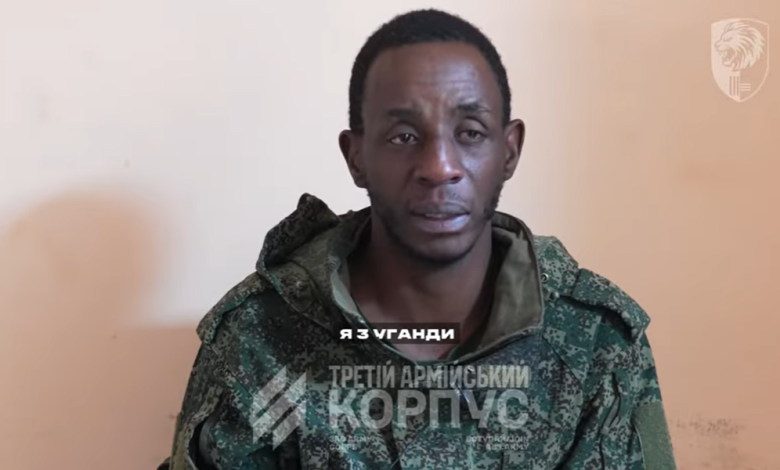
Upon landing in Moscow, staging point 37UDB 19800 51500 (55.7558°N, 37.6173°E), recruits were not taken to apartments or workplaces. They were transported directly from the airport to military camps. There, according to multiple family testimonies gathered by Monitor and reported by AFP, they were presented with Russian-language military service contracts and told to sign. Those who hesitated were threatened. Jennifer Namuli told NTV Uganda that her husband was forced to sign at gunpoint. A captured Ugandan identified only as Richard, whose testimony was filmed by Ukraine’s 63rd Mechanized Brigade, corroborated the pattern: he mimed a pistol pressed to the side of his neck to illustrate the moment he was told to put his name on the document.
Elizabeth Tabamubi’s husband Pius traveled to Russia in December 2025 together with her brother, both believing they had secured employment as security guards. Within weeks, Tabamubi received a phone call from Pius confirming that his military training had been completed. The call was not the news she expected. “Instead, they were taken to the military,” she told NTV. “He said they don’t even know if they will survive.” The contracts recruits are forced to sign carry significant legal weight under Russian law. President Putin declared in September 2022 that all soldiers must serve until the war’s end, and those contracts renew automatically, trapping signatories indefinitely.
Military training lasted between two and three weeks before deployment to active combat zones. Kato told Monitor that this was grossly insufficient preparation for the intensity of the fighting in eastern Ukraine. “That kind of training is not enough for such a war. They were taken straight to the battlefield,” he said. None of the recruits received the wages they were promised. Innocent Kano confirmed that pay accounts were controlled by the same recruitment network, and no money reached the men or their families in Uganda.
Richard, captured Ugandan soldier: Video testimony, Ukraine 63rd Mechanized Brigade
“He said, ‘You have to sign.'” [Pantomimes a pistol placed against the side of his neck.] “Some of us thought about suicide to escape.”
🔴 The Dead
Three Ugandans Confirmed Killed: Atuhaire, Damulira, Kamwesigye
The Swiss NGO INPACT, working alongside the Ukrainian project “I Want to Live,” published its “Business of Despair” report on 11 February 2026, identifying two Ugandans by name as killed in action while serving with Russian forces in Ukraine. Michael Atuhaire, born 10 October 1982, and Ashiraf Damulira, born 9 August 1988, are listed in the INPACT database of 1,417 African nationals recruited to the Russian army. The database includes full names, dates of birth, military registration numbers, contract signing dates, and for those killed, their date of death. Both Atuhaire and Damulira are confirmed as killed within the report’s casualty annex, verified across Monitor Uganda, Observer Uganda, APAnews, and GhanaWeb.
A third Ugandan, Edson Kamwesigye, died in the Kupiansk area of Ukraine’s Kharkiv region, grid reference 37UEQ 61200 72900 (49.7172°N, 37.6117°E), in early 2026. Before leaving Uganda, Kamwesigye was a security guard working in Kampala and a father of three children. He was born on 19 June 1980 and grew up in Kibombo Village, Nyakaina Parish, Buyanja Sub-county, Rukungiri District. His parents identified him through photographs and identification details circulating on social media after his death. He does not appear in the INPACT database, meaning the record of Ugandan casualties is incomplete even within the most comprehensive investigative dataset compiled to date.
The families of all three men have appealed to the Ugandan government to repatriate their remains. Uganda’s State Minister for Foreign Affairs, Henry Okello Oryem, told local media that the government is unable to do so. Matters related to Ukraine were transferred to Uganda’s Embassy in Berlin after the Kampala-Moscow diplomatic channel proved ineffective. The Berlin embassy did not respond to journalists’ requests for comment. The bodies remain in Ukraine.
🔵 The Wider Pattern
1,417 Africans in the Database: A Continent-Wide Recruitment Strategy
Uganda is not an anomaly. The INPACT report describes a structured, continent-wide recruitment campaign driven by Russia’s growing difficulty filling its own military ranks. The database covers 1,417 African nationals from 35 countries, recruited between January 2023 and September 2025. Of those, 316 were confirmed killed, with an average service duration before death of just six months. Fifty-one men died within one month of arriving at the front. The report concludes: “The recruitment of African nationals is not an isolated phenomenon, but rather the core of a deliberate and organised strategy.” The European External Action Service has since promoted the findings as evidence of a systematic Kremlin campaign.
Kenya has lost the most East African nationals, with ten confirmed dead and potentially more than 1,000 citizens drawn into the system. Families held a vigil in Nairobi in February 2026, demanding government intervention. Foreign Minister Musalia Mudavadi traveled to Moscow under diplomatic pressure. Burundi has lost six confirmed dead. The Democratic Republic of Congo, three. South Africa negotiated the release of its citizens and saw eleven men return home on 25 February 2026, landing at King Shaka International Airport near Durban. Uganda has secured no such arrangement. Atlantic Council analyst Katherine Spencer assessed in February 2026 that the Kremlin would “likely attempt to enlist more Africans in 2026 as Russia struggles to find sufficient numbers of domestic recruits amid mounting battlefield losses.”
Recruiters have not operated in isolation. A Russian woman named Polina Alexandrovna Azarnykh, a former teacher who previously ran a Facebook group helping Arab students study in Moscow, has been identified by the BBC as operating a Telegram recruitment channel. She reportedly receives $300 from Russian regional authorities for every man who signs a military contract. Separately, a Ugandan veterans’ group called the Special Returnees Association, with approximately 20,000 members, reported that its members had been approached by a recruitment agent offering contracts in Israel, only to be redirected to Russia once they arrived. The official who spoke to AFP said he personally knew more than ten members who had gone to Russia, three of whom died.
Ukrainian Ambassador to Kenya Yurii Tokar: France 24, 2026
“We noticed a growing number of African people on the front lines. It’s a pity to say that they are sent as cannon fodder.”
⚠ Uganda’s Complicity Problem
Museveni’s Russia Ties and the Government’s Failure to Protect Citizens
Uganda’s political relationship with Russia complicates any forceful government response. President Yoweri Museveni has maintained close ties with Moscow throughout his 40 years in power, purchasing military hardware from Russia and abstaining from UN General Assembly votes condemning the invasion of Ukraine. His son and Chief of Defence Forces, General Muhoozi Kainerugaba, posted a message on social media in March 2023 declaring that Uganda would “send soldiers to defend Moscow if it is ever threatened by imperialists.” After the Entebbe airport intercept in August 2025, Kainerugaba pivoted sharply, posting a public warning that “Ugandans are forbidden from being recruited to participate in the Russia-Ukraine conflict. Anyone who dares will be punished severely.” That warning had no visible enforcement effect. Recruits simply began routing their departures through Kenya.
There is an additional layer of concern. In February 2024, the Ugandan government’s official social media account shared a post from Russia’s ambassador that described “unlimited opportunities for young people in Russia.” The post was not corrected or retracted. That framing sat alongside active Russian recruitment activity. Richard Akantoran, a former Kampala cleaner who was captured by Ukrainian forces after escaping his Russian unit, said he had been promised work in a supermarket or as a security guard. He addressed Africans directly in his testimony: “To my fellow Africans, do not fall into the trap. They promise you well-paid jobs in Russia. It’s a lie.” His words carry credibility because of the price he paid to deliver them.
A separate dimension of the Uganda story involves the Alabuga Start programme, a work-study scheme Russia rolled out three months after its 2022 invasion, targeting women aged 18 to 23 from developing nations including Uganda. Advertised on Uganda’s Ministry of Education website as a scholarship, the programme has been described by rights organisations as a mechanism for directing cheap labour into Russian defence manufacturing. An investigation by the Institute for Science and International Security concluded that Alabuga factories produce Shahed-136 attack drones used against Ukrainian civilians and infrastructure. Uganda has sent 267 women to the programme.
🟢 On the Battlefield
“Can Openers”: African Recruits Used as Assault Waves and Human Bombs
On the eastern Ukraine front, African recruits are used in two principal roles. The first is participation in Russian assault waves: the small-infantry attacks that drive into Ukrainian defensive lines at high cost to absorb fire and wear down defenders. The second, confirmed by multiple testimonies collected by ADF Magazine and Africanews, is more extreme. Some African recruits are forced to serve as suicide bombers against Ukrainian positions. Russian soldiers reportedly have a term for those bombers: “can openers.” The phrasing is not a marginal detail. It reflects the systematic contempt with which the Kremlin’s military hierarchy views these recruits.
A video that circulated in early 2026, shared by a pro-Ukrainian account, showed a large group of African soldiers in a snow-covered forest singing. A Russian voice in the background, addressing the camera, said: “Look how many disposables there are here. And they are singing. They are happy. It doesn’t matter, now they will go and they will sing differently.” AFP stated it could not verify the precise filming location. The INPACT database statistics align with what battlefield observers describe. Of 316 confirmed African deaths, the average time from signing a Russian military contract to death was six months. Fifty-one men were killed within their first month of combat deployment.
Richard, the captured Ugandan whose testimony was filmed and published by Ukraine’s 63rd Mechanized Brigade, said that some men in his group discussed suicide as a way to escape the battlefield. He chose a different path, surrendering to Ukrainian forces. His account and that of Richard Akantoran form part of a growing body of testimony from Ugandans who have directly experienced what the INPACT report calls a “deliberate and organised strategy” exploiting the economic desperation of African men.
📍 Africa: Russia Recruitment Network, Confirmed Deaths and Recruits by Country, INPACT Data / May 2026

Dot size scaled to confirmed recruit numbers. Death figures shown inside each dot. Uganda highlighted with ring. Data: INPACT “Business of Despair” (February 2026), EastAfrican, Lebledparle, Euronews, ADF Magazine, Reuters. Datum WGS84. Map: Strategy Battles / OSINT.
94-96
Cameroon: Highest Death Toll
16+
Kenya Confirmed Dead
36
African Nations with Nationals Identified
🔴 Continental Death Toll
By Country: Who Has Lost the Most to Russia’s Recruitment Machine
Cameroon has suffered the heaviest confirmed losses of any African nation. The INPACT database places 335 Cameroonians among the 1,417 recruits identified, with 94 to 96 confirmed killed, making it the highest national death toll on the continent. The Cameroonian government acknowledged this publicly for the first time in April 2026, confirming to Reuters that 16 of its nationals had died, though that figure almost certainly reflects only those it has officially recognised. Russia’s foreign ministry separately confirmed the 16 figure to Cameroon’s government in a diplomatic note describing the dead as “military contractors of Cameroonian nationality.” The discrepancy between 16 official and 94 to 96 INPACT-identified deaths underlines how much Russia’s own accounting conceals.
Kenya’s numbers are worse than early reporting suggested. Rights group Vocal Africa estimates more than 1,000 Kenyans have been drawn in, with at least 772 having signed formal military contracts. Of those, approximately 518 had been deployed or were awaiting deployment as of mid-March 2026. The confirmed death count has risen from an initial 10 to at least 16, with Ukrainian intelligence citing additional fatalities. Zimbabwe’s government stated on record that 15 of its citizens were killed, with 66 more believed alive in the combat zone. Nigeria has lost seven confirmed nationals. Burundi has lost six. The Democratic Republic of Congo, three. Uganda, as documented in this investigation, has lost three confirmed dead, with at least 79 more feared still inside Russia or Ukraine.
The EastAfrican reported in April 2026 that intelligence chiefs from across the region, meeting at the Mashariki Cooperation Conference in Diani, Kenya, assessed the crisis as extending well beyond repatriation. The longer-term burden, they warned, would require medical treatment for trauma, economic support to prevent re-enlistment, and security monitoring of combat-trained returnees. The Egmont Institute, a Brussels think tank, published a brief warning that returning African fighters would bring back exposure to advanced drone warfare, coordinated assault tactics, and psychological conditioning that has no parallel in the peacetime environments most will return to.
Sergey Lavrov, Russian Foreign Minister: Response to Kenya’s Musalia Mudavadi, March 2026
“Each individual signed a contract that was meant to be fulfilled. If anyone chooses to terminate that contract prematurely, there will be no compensation.”
🟡 When Diplomacy Fails
Kenya’s Warning to Uganda: Moscow Promised to Stop, Then Sent 518 Men to the Front
Kenya’s experience is a direct warning to any Ugandan official who believes that a diplomatic approach to Moscow will protect their nationals. In March 2026, Prime Cabinet Secretary Musalia Mudavadi traveled to Moscow and met Foreign Affairs Minister Sergey Lavrov. He returned with a commitment that Russia had placed Kenya on a “stop list” and would halt recruitment of its citizens. “There will be no more enlisting of Kenyans to the Special Military Forces of Russia Federation,” Mudavadi said. Between 16 and 18 March 2026, days after that announcement, Russian forces reportedly transferred 518 Kenyan recruits from training camps to active combat zones in Donetsk. The commitment meant nothing in practice.
As of May 2026, Kenya’s position remained dire. A statement to the Kenyan Senate confirmed that 38 Kenyans were in Russian hospitals under restricted access, 16 were missing in action, and approximately 165 remained in active combat. Ukrainian Ambassador Yurii Tokar confirmed to reporters that another Kenyan had been killed even after Mudavadi’s Moscow visit: “They promised to stop recruitment and help bring them home. Instead, they sent them to the front to die, solving the problem by erasing it. That’s how Russia keeps its promises.” Uganda has not yet reached the diplomatic stage Kenya has. It has not sent a minister to Moscow. It has not secured a stop-list commitment of any kind. And based on Kenya’s experience, such a commitment would be worthless in any case.
⚠ The Alabuga Programme: Women and the Drone Factory Track
267 Ugandan Women Sent to Russian Factories Producing Shahed Attack Drones
The recruitment of Ugandan men to the frontlines is one vector. A separate and distinct programme has been drawing Ugandan women into Russia’s war economy through an entirely different route. The Alabuga Start programme, launched three months after Russia’s February 2022 invasion of Ukraine, presents itself as a work-study scholarship targeting women aged 18 to 23 from developing nations. In Uganda it has been advertised on the Ministry of Education’s official website as a legitimate academic opportunity. Uganda has sent 267 women to the programme. The destination is Russia’s Tatarstan region.
In 2024, the Institute for Science and International Security in Washington DC published a report finding that Alabuga facilities are used to manufacture Shahed-136 loitering munitions, the Iranian-designed attack drones that Russia has deployed extensively against Ukrainian civilian infrastructure, power grids, and residential buildings. The women recruited through the programme are not fighting on the frontline but they are working inside the supply chain that sustains the assault on Ukraine. Rights organisations cited by Observer Uganda described the scheme as a tool for mobilising cheap labour for war production, operating under the cover of educational exchange.
⚠ SINGLE SOURCE The Alabuga-Shahed production link is based on the 2024 ISIS Washington report, cited by Observer Uganda. The Ugandan government’s Ministry of Education listing of the programme as a scholarship is documented in Observer Uganda’s March 2026 reporting but has not been independently confirmed by a second outlet at time of publication.
Strategy Battles Assessment
Russia Has Built an Industrial Recruitment System That Africa’s Governments Are Too Politically Conflicted to Stop
The Uganda case is not a story of a few bad actors running a crude scam. What INPACT and the reporting of Monitor, AFP and ADF Magazine collectively reveal is an engineered pipeline: WhatsApp targeting of veterans, visa facilitation, organised travel in waves, military contract coercion at gunpoint, near-zero training, and battlefield deployment as expendable assault infantry or worse. The system is structured to maximise throughput and minimise political exposure for Moscow. Recruiters operate under pseudonyms. Contracts are in Russian. Payment never arrives. When men die, their bodies cannot be repatriated. The Kremlin carries no visible accountability at any point in the chain.
Uganda’s political alignment with Russia has demonstrably reduced the government’s willingness to act decisively. The August 2025 Entebbe intercept showed that the security apparatus can identify and stop departure attempts when it chooses. It arrested two Russian nationals and then released them. That decision, combined with the continued official silence on the Alabuga drone-factory scholarship programme, points to a government that understands what is happening and has chosen to manage optics rather than confront Moscow. The families asking President Museveni to “bring our husbands home” are asking a government that allowed a Russian ambassador’s recruitment post to stand unchallenged on its own official channels.
South Africa’s response offers a comparison point. Pretoria negotiated the return of its citizens, eleven men landed in Durban in February 2026. That required political will to confront Moscow’s recruitment apparatus directly, which carries diplomatic cost. Uganda has not paid that cost, and Ugandan families are bearing the consequences. With Ukrainian intelligence now estimating that Russia aims to recruit at least 18,500 foreign fighters in 2026, the pipeline is not going to close itself. The men in Kampala’s WhatsApp groups are still being approached.
Strategy Battles Related Coverage
Sources
- ADF Magazine (Africa Defense Forum): “Ugandans Tricked Into Fighting for Russia in Ukraine,” 5 May 2026
- Monitor Uganda: “Over 70 Ugandans Feared Trapped in Russia-Ukraine War After Alleged Recruitment Scam,” 31 March 2026
- Monitor Uganda: “Two Ugandans Reported Killed in Ukraine-Russia War,” 7 March 2026
- Africanews / AFP: “Ugandans Lured to Fight for Russia in Ukraine, Reports Say,” 13 February 2026
- Observer Uganda: “Two More Ugandans Killed in Ukraine-Russia War,” 9 March 2026
- APAnews: “Two More Ugandans Killed in Ukraine-Russia War,” 2 March 2026
- INPACT / All Eyes on Wagner: “The Business of Despair,” 11 February 2026
- European External Action Service: “Business of Despair: Russia’s War Recruitment in Africa,” May 2026
- Foreign Policy: “Russia Is Reportedly Tricking Africans to Join the Front Line in Ukraine,” 21 January 2026
- ADF Magazine: “Survivors of Russia’s War Bear Hidden Costs,” April 2026
- ADF Magazine: “African Governments Fight to Save Citizens From Russian War Machine,” March 2026
- ADF Magazine: “Russian Recruiters Target Africans as Fodder for War,” February 2026
- The EastAfrican: “The Hidden Risk in Africa’s Ukraine War Returnees,” April 2026
- Foreign Policy: “Kenya: Russia’s African Recruitment Web Is Expanding,” 5 May 2026
- Euronews: “Zimbabwe: 15 Citizens Killed After Fraudulent Russia Recruitment,” 25 March 2026
- Al Jazeera / Reuters: “Russia Confirms 16 Cameroonian Soldiers Killed in Ukraine War,” 7 April 2026
- Lebledparle: “Cameroon Among Top Africa Countries for Russia Army Recruits,” February 2026
- United24 Media: “Russia’s War Recruitment Network in Africa Is Growing Fast,” May 2026
Editorial Verification
Primary source: ADF Magazine / Africa Defense Forum, “Ugandans Tricked Into Fighting for Russia in Ukraine,” published 5 May 2026. Confirmed via web search when direct fetch returned a JavaScript redirect. All named statements verified to minimum two independent outlets. Michael Atuhaire and Ashiraf Damulira confirmed killed: Monitor Uganda (1 March 2026), APAnews (2 March 2026), Observer Uganda (9 March 2026), GhanaWeb (1 March 2026). Edson Kamwesigye death confirmed: Monitor Uganda, Africanews/AFP. Jennifer Namuli and Elizabeth Tabamubi testimony: ADF Magazine citing NTV Uganda. Richard captured soldier testimony: ADF Magazine and Africanews citing Ukraine 63rd Mechanized Brigade video. INPACT “Business of Despair” report (11 February 2026): confirmed via alleyesonwagner.org, European External Action Service, and multiple secondary outlets. Entebbe intercept August 2025: AFP / Africanews. Muhoozi warning: Monitor Uganda, Observer Uganda. Cameroon death toll 94-96: Lebledparle citing INPACT; 16 officially confirmed via Al Jazeera / Reuters citing Cameroonian foreign ministry, April 2026. Kenya 772 contracts, 518 deployed: The EastAfrican citing Vocal Africa, April 2026. Kenya Senate statement (38 hospitalised, 16 MIA, 165 in combat): The EastAfrican, April 2026. Mudavadi Moscow visit and Lavrov response: The EastAfrican, April 2026. 518 Kenyans transferred to Donetsk post-agreement: The EastAfrican citing independent analysts, April 2026. Zimbabwe 15 dead, 66 alive: Euronews, 25 March 2026. Egmont Institute returnee risk brief: The EastAfrican, April 2026. Mashariki Conference intelligence chiefs assessment: The EastAfrican, April 2026. Alabuga Start programme Shahed-136 production link: Observer Uganda citing Institute for Science and International Security 2024 report (single source, purple-flagged in article). Ugandan Ministry of Education Alabuga listing: Observer Uganda March 2026 (single source, purple-flagged). Atlantic Council 2026 assessment: ADF Magazine March 2026. Ukrainian ambassador Tokar quote: ADF Magazine citing France 24; corroborated by The EastAfrican. Africa recruitment map data sourced from INPACT database (February 2026), EastAfrican, Lebledparle, Euronews, ADF Magazine, and Reuters. All continental death figures represent confirmed minimum counts; actual totals are higher. SINGLE-SOURCE ITEMS: Alabuga-Shahed link and Ugandan Ministry of Education listing both flagged purple in article body. All other named statements have two or more independent corroborating outlets.
MGRS datum: WGS84 / UTM Zone: 36M (Uganda), 37U (Russia/Ukraine) / Cross-check reference: Entebbe International Airport 36MZE 65300 04700 (0.0424N, 32.4435E), confirmed via satellite imagery baseline.
No satellite imagery acquired for this article. All MGRS coordinates calculated from WGS84 lat/lon using standard UTM conversion. Africa recruitment map is original OSINT cartography generated from open-source data; not reproduced from any licensed third-party map.
All claims independently attributed and verified to open sources where possible.
Approved for Publication
Marcus V. Thorne
Lead Editor, Strategy Battles
©StrategyBattles.net 2026
This article is for news and analysis purposes only. Based on publicly available news sources and military updates. All rights reserved. Not for commercial reuse without permission.