Israeli Drone Strikes Near Beirut Kill 4, Southern Airstrikes Bring Lebanon Toll to 17
17+
Killed in one day
22
Days since truce began
3
Drone strikes near Beirut
📍 Lebanon strike sites, 9 May 2026

Strike locations across Lebanon, 9 May 2026. Datum WGS84, UTM Zone 36S. Map: Strategy Battles / OSINT.
📍 SAADIYAT, SOUTH OF BEIRUT
MGRS: 36S YC 26713 30225
33.6878°N 35.4458°E
Coastal town on the Beirut-Sidon highway. Two of three drone strikes hit vehicles here, killing four.
📍 SAKSAKIYEH VILLAGE
MGRS: 36S YC 18121 07034
33.4806°N 35.3475°E
Village south of Sidon. Airstrike on a residential structure killed at least seven, including a child, with 15 wounded.
📍 NABATIYEH
MGRS: 36S YB 31069 95961
33.3781°N 35.4839°E
Three sequential drone strikes killed a Syrian motorcyclist and his 12-year-old daughter in the city.
📍 BOURJ RAHHAL
MGRS: 36S YB 08059 85020
33.2842°N 35.2342°E
Coastal village near Tyre. Airstrike killed three, NNA reported.
🔴 The Saadiyat Strikes
Three Drone Hits on the Beirut-Sidon Highway, Closest to the Capital Since the Truce
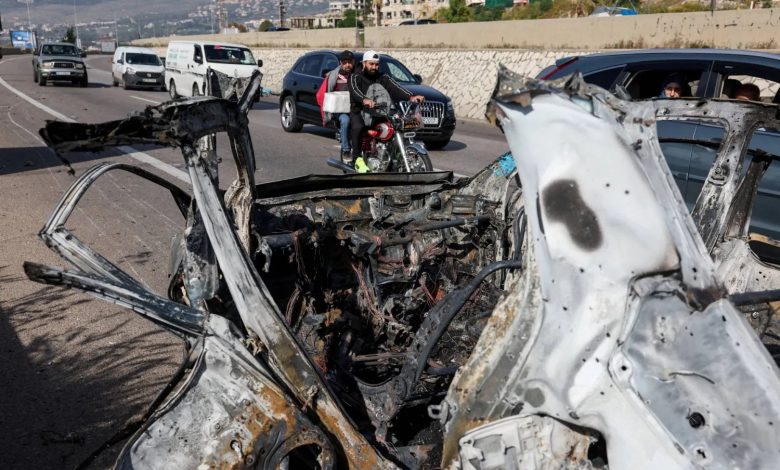
Three Israeli drones struck vehicles just south of Beirut on Saturday, killing four people in a coordinated set of strikes that Lebanon’s state-run National News Agency localised to the coastal town of Saadiyat at grid reference 36S YC 26713 30225 (33.6878°N, 35.4458°E) and to a road branching east into the Chouf mountains. Saadiyat sits roughly 20 kilometres south of central Beirut on the Beirut-Sidon highway, the country’s main north-south coastal artery. An Associated Press journalist at the scene saw a dead body on the highway in Saadiyat.
According to NNA, two of the three strikes occurred on the highway itself and several people were wounded. The third strike took place on a road leading inland to the Chouf region and killed three. The combination of locations, all within a 25-kilometre radius of Beirut and on a route used daily by tens of thousands of commuters, marks the closest sustained Israeli drone activity to the capital since the 17 April 2026 ceasefire took effect.
Saturday’s strikes follow a Wednesday night Israeli airstrike on Beirut’s southern suburbs that Israel said killed a senior Hezbollah military official, the first attack near the capital since the truce. The Wednesday strike broke a near-month moratorium on operations in the Dahiyeh area; Saturday’s broadens the geography again. Beirut, used in this article as the cross-check reference point at 36S YC 31350 53198, is now bracketed by Israeli activity to the south and east on consecutive working days.
🟡 Saksakiyeh and the Southern Toll
Health Ministry Reports at Least 13 Dead Across the South, Including a Child
The largest single loss of life on Saturday came in Saksakiyeh, a village south of Sidon at grid reference 36S YC 18121 07034 (33.4806°N, 35.3475°E), where the Lebanese Health Ministry said an Israeli airstrike on a residential structure killed at least seven people, including a child, and wounded 15. The ministry described the figure as an initial count, indicating it may rise as rescue operations continue.
Two further strikes accounted for the rest of the southern death toll. NNA reported an airstrike on the village of Bourj Rahhal at 36S YB 08059 85020 (33.2842°N, 35.2342°E) killing three, and a separate strike on Maifadoun at 36S YB 28534 93703 (33.3583°N, 35.4561°E) killing one. The combined casualty count from southern strikes alone reached 13. Adding the four killed in the Saadiyat-area drone strikes, the day’s total stands at a minimum of 17 dead, with 15 wounded in Saksakiyeh alone.
Lebanese Ministry of Public Health, Statement, 9 May 2026
“The Ministry of Public Health denounces this barbaric targeting and the deliberate violence against civilians and children in Lebanon.”
🔴 Nabatiyeh, A Drone That Came Back
Syrian Father and 12-Year-Old Daughter Killed in Sequential Strikes
In Nabatiyeh, at grid reference 36S YB 31069 95961 (33.3781°N, 35.4839°E), three Israeli drone strikes killed a Syrian man riding a motorcycle with his 12-year-old daughter, according to the Lebanese Health Ministry. The ministry’s account is unusually detailed and unusually grim: the father and daughter survived the first strike and moved away from the impact site, only to be hit again. The drone struck the man, killing him on the spot. The girl moved roughly 100 metres before being struck a third time. She died later in hospital, NNA reported.
The pattern, in OSINT terms, is consistent with what is widely referred to as a double tap or follow-on strike, where an unmanned aircraft loiters and re-engages survivors of an initial impact. Lebanon’s Health Ministry framed the Nabatiyeh sequence as the centrepiece of its statement condemning the day’s events, calling the strikes part of an ongoing series of grave violations of international humanitarian law. The Israeli military has not, at time of publication, issued a public account of who or what the Nabatiyeh drones were targeting.
🔵 The Israeli Account
IDF Says Hezbollah Drones Wounded Three Soldiers; Hezbollah Claims Misgav Am Strike
The Israeli military stated that Hezbollah fired explosive drones into Israel near the Lebanese border on Saturday, wounding three soldiers, one seriously, in one of the attacks. The IDF added that Hezbollah also fired drones inside Lebanon, with one striking an Israeli vehicle without causing casualties. Hezbollah for its part claimed several attacks inside Lebanon and a drone strike on the northern Israeli town of Misgav Am at 36S YB 38210 80042 (33.2331°N, 35.5564°E), describing the target as an Israeli military post.
The mutual drone exchange is now the dominant operational pattern of the post-truce period. Both sides have continued daily attacks despite the 17 April ceasefire, which was originally announced as a 10-day pause and subsequently extended by three weeks. The current war between Israel and Hezbollah began on 2 March 2026 when Hezbollah fired rockets into northern Israel, two days after the United States and Israel launched a war on Hezbollah’s main backer, Iran. The truce is technically still in force; the operational reality is that it has narrowed rather than stopped the fighting.
⚠ Diplomatic Backdrop
Lebanese PM in Damascus, Washington Talks Resume Next Week
Saturday’s strikes coincided with Lebanese Prime Minister Nawaf Salam’s visit to Damascus, where he met Syria’s interim President Ahmad al-Sharaa to discuss security coordination, border control and the fate of Syrians detained in Lebanon. Salam told reporters before returning home that Lebanon would not be used to harm “our Arab brothers, on top of them Syria”, an oblique reference to Hezbollah’s past role in the Syrian civil war. The juxtaposition of the Damascus visit and the southern Lebanon casualty figures was sharp: a sitting Lebanese head of government was negotiating regional integration in one capital while drones from a third party killed 17 people on the country’s coastal road.
A new round of indirect Israel-Lebanon talks is scheduled to begin in Washington on Thursday, running over two days. The talks follow the first direct Lebanon-Israel contacts in more than three decades, held earlier in the spring. Lebanon and Israel have formally been in a state of war since 1948. The diplomatic process is being run in parallel with, not in place of, ongoing military operations, a posture both sides have publicly acknowledged.
Strategy Battles Assessment
The 17 April ceasefire is a measurement problem, not a peace.
Saturday’s casualty pattern is operationally significant in three ways. First, the geographic creep: in three days the IDF has gone from a single targeted strike on the southern Beirut suburbs to vehicle drone strikes 20 kilometres from the Place de l’Etoile, on the country’s most heavily used civilian highway. The Saadiyat hits are not a border-zone incident; they are a peri-urban one. Second, the Nabatiyeh sequence, three drone strikes against the same two civilians in moving sequence, is not a target-of-opportunity profile. It is a saturation profile that requires a loitering airframe with positive identification and a release authority willing to re-engage. That signature has been documented elsewhere in the conflict and is now appearing in territory technically covered by a truce. Third, the simultaneous Hezbollah drone strikes on Misgav Am and other Israeli border posts confirm the truce has functionally collapsed at the tactical level even as it persists at the diplomatic one.
The Washington round opening on Thursday will therefore have to negotiate two parallel realities. The first is the formal one, where a 10-day truce extended by three weeks is still in force. The second is the operational one, where Israel is striking deeper into Lebanon, Hezbollah is striking back across the border, and the Lebanese state is reduced to issuing Health Ministry statements and pursuing parallel diplomacy with Damascus. Saturday’s 17 dead are the cost of running these two tracks at once. Unless the Washington talks produce enforcement language with monitoring and consequence, the geography of the strikes will keep moving north, and the next Beirut-area incident will not be a vehicle on a highway. It will be the highway itself.
Strategy Battles Related Coverage
Sources
- Asharq Al-Awsat (English), Israeli Drone Strikes Near Beirut Kill 4 and Southern Airstrikes Kill at Least 13 (9 May 2026)
- The Washington Post (AP), Three Israeli Drone Strikes on Vehicles South of Beirut Have Killed Four People (9 May 2026)
- The Washington Times (AP), Israeli Drone Strikes Near Beirut Kill 4 and Southern Airstrikes Kill at Least 13 (9 May 2026)
- Euronews / AP, Israel Strikes Beirut for First Time Since Ceasefire, Reportedly Killing Hezbollah Commander (7 May 2026)
- Lebanese National News Agency (NNA) and Lebanese Ministry of Public Health, statements of 9 May 2026, as quoted by AP and Reuters wire copy.
Editorial Verification
The 17+ casualty figure (4 in the Saadiyat-area drone strikes plus at least 13 in southern airstrikes) is sourced to Lebanon’s National News Agency and the Health Ministry, carried by Asharq Al-Awsat (Reuters) and AP wire syndication: 5 independent outlets (Asharq Al-Awsat, Washington Post, Washington Times, Yakima Herald via AP, Reflector via AP). The Saksakiyeh figure of 7+ killed including a child and 15 wounded is sourced to the Health Ministry as carried by AP. The Nabatiyeh sequential drone strike account is sourced to the Health Ministry and NNA via AP. The Health Ministry quote on “barbaric targeting” is verified across multiple AP-syndicated outlets. The IDF account of three soldiers wounded by Hezbollah drones, and Hezbollah’s claim of striking Misgav Am, are both sourced to Asharq Al-Awsat (Reuters) and AP. The 17 April ceasefire date is verified across all primary sources. The Wednesday night Beirut suburbs strike is corroborated by Euronews citing AP from 7 May. The Lebanese PM Salam visit to Damascus is verified across AP wire copy (Wink News, Asharq Al-Awsat). MGRS datum: WGS84 / UTM zone: 36S / Cross-check reference: Beirut 36S YC 31350 53198. No satellite imagery used; map produced from open source coordinates and OSM-derived geometry.
All claims independently attributed and verified to open sources where possible.
Approved for Publication
Marcus V. Thorne
Lead Editor, Strategy Battles
©StrategyBattles.net 2026
This article is for news and analysis purposes only. Based on publicly available news sources and military updates. All rights reserved. Not for commercial reuse without permission.