BAE Systems Wins $45.5M Trident II D5 Contract as U.S.-UK Deterrent Modernisation Accelerates
🔵 The Contract
BAE Systems Picks Up Its 51st Modification on the Trident Programme — A Signal of Sustained Dependency
BAE Systems has been awarded a $45.5 million contract modification to continue engineering and technical support for the U.S. Navy’s Trident II D5 Strategic Weapon Systems Programme. The award, announced by the U.S. Department of Defense on April 23, 2026, is the 51st modification to a long-running existing contract — making it one of the most continuously extended defence relationships in American procurement history.
The work covers four core technical disciplines: systems engineering and integration, test engineering, data analysis, and safety engineering. These disciplines span the entire weapon system architecture — from the missile itself through to the fire control, navigation, and launch interfaces aboard the host submarine. Completion is expected by September 30, 2026.
The contract was awarded on a sole-source basis, meaning no competitive bids were solicited. The contracting activity is PAE Strategic Systems Programs in Washington, D.C. The award also directly benefits a Foreign Military Sale to the United Kingdom, reflecting the intertwined nature of the two nations’ nuclear deterrent architecture under the Polaris Sales Agreement first signed in 1963.
🟡 The Weapon System
What the Trident II D5 Is — and Why Keeping It Current Is Non-Negotiable
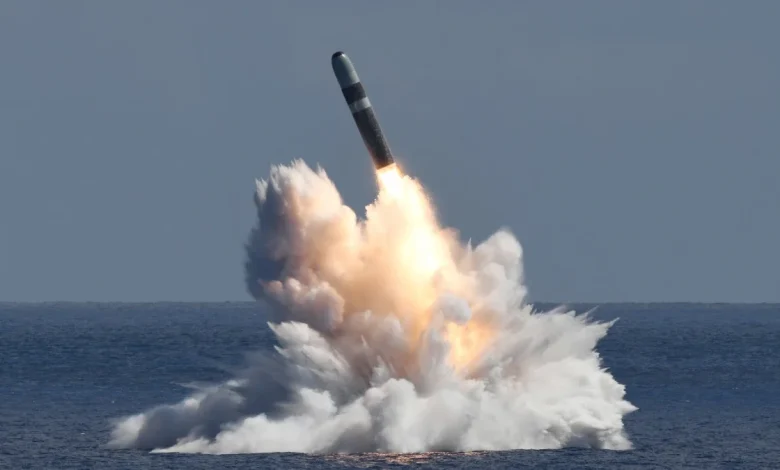
The UGM-133A Trident II D5 is a three-stage, solid-fuelled submarine-launched ballistic missile first deployed in March 1990. Built by Lockheed Martin Space in Sunnyvale, California, it is the primary sea-based nuclear deterrent for both the United States Navy and the Royal Navy. At 13.42 metres in length and weighing approximately 59,090 kilograms at launch, it carries a Post-Boost Vehicle capable of deploying up to eight independently targetable re-entry vehicles under current New START limits, with warhead options including the W76 100 kiloton and W88 475 kiloton variants.
Its guidance system combines inertial navigation with stellar reference updates during the boost phase, delivering a circular error probable of approximately 90 metres at intercontinental range. This level of precision — approaching that of land-based ICBMs — makes it capable of engaging hardened targets, not just counter-value soft targets. The U.S. Navy currently operates 14 Ohio-class submarines each carrying up to 20 Trident D5 missiles, giving an active arsenal of around 240 deployed SLBMs. The Royal Navy operates four Vanguard-class submarines, each carrying up to 16 missiles.
The sea-based leg of the nuclear triad is widely regarded by strategists as its most survivable component. Submarines on patrol are effectively invisible to adversary targeting — unlike fixed ICBM silos or bomber bases that can be mapped, tracked and struck in a first strike. The Trident D5’s range in excess of 12,000 kilometres means that a submerged Ohio-class boat can reach any target on earth from a vast patrol area, removing the need to position submarines close to adversary coastlines.
🔵 BAE Systems’ Role
The Technical Glue — BAE as the Integration Layer Across a Multi-Billion-Dollar Deterrent Stack
BAE Systems’ Rockville, Maryland operation serves as what analysts describe as the technical integration layer for the broader Trident weapon system enterprise. While Lockheed Martin acts as prime contractor for the missile itself and General Dynamics Mission Systems holds the fire control modernisation contract, BAE’s role is to ensure that every layer of the system remains synchronised, current, and safe — across the missile, the submarine’s fire control architecture, and the launch interfaces.
Work under this modification is distributed across a broad geographic footprint. The largest concentration of activity sits in Rockville, Maryland, with additional work at Cape Canaveral, Florida; Frederick, Maryland; Silverdale, Washington; Saint Mary’s and King’s Bay, Georgia; York, Pennsylvania; Fort Walton Beach, Florida; and the UK city of Rochester. Smaller locations account for approximately eight percent of the total task distribution.
The Rochester, UK presence is particularly notable. It reflects the direct integration of BAE’s support role into Royal Navy Trident operations, and underscores the degree to which the UK’s independent nuclear deterrent is institutionally bound to the American industrial and engineering infrastructure that sustains the shared missile design.
🟢 The Wider Modernisation Picture
Increment 8, Columbia Class, and a $3 Billion Push to Sustain the West’s Sea-Based Deterrent to 2080
BAE’s contract sits inside one of the most intensive periods of Trident modernisation since the missile first entered service. The U.S. and UK navies are preparing to launch Trident II D5 Increment 8 in October 2026, a programme specifically targeting the shipboard navigation subsystem across Ohio and Columbia-class submarines in the U.S. fleet and Vanguard and Dreadnought-class boats in the UK. The effort is led by Lockheed Martin and is valued at approximately $3 billion from the U.S. Navy’s FY2026 budget line, supplemented by additional funding from the One Big Beautiful Bill Act.
Lockheed Martin separately received an $850 million contract modification for continued Trident II design and development work through September 2030. In a parallel award, General Dynamics Mission Systems was contracted for $255 million to sustain and modernise the Trident II Fire Control System specifically for Columbia-class compatibility. That contract covers the development, production, and installation of new fire control systems through 2032. The Columbia class is scheduled to enter service in the early 2030s and will carry 16 Trident D5 missiles in a quad-pack configuration.
Lockheed Martin is also constructing a new production facility in Titusville, Florida, to manufacture components for the next generation of Trident D5 missiles under the D5LE2 (Life Extension 2) programme. The intent is to sustain the Trident II’s operational credibility well into the 2040s on current-generation submarines and beyond that on Columbia and Dreadnought-class boats.
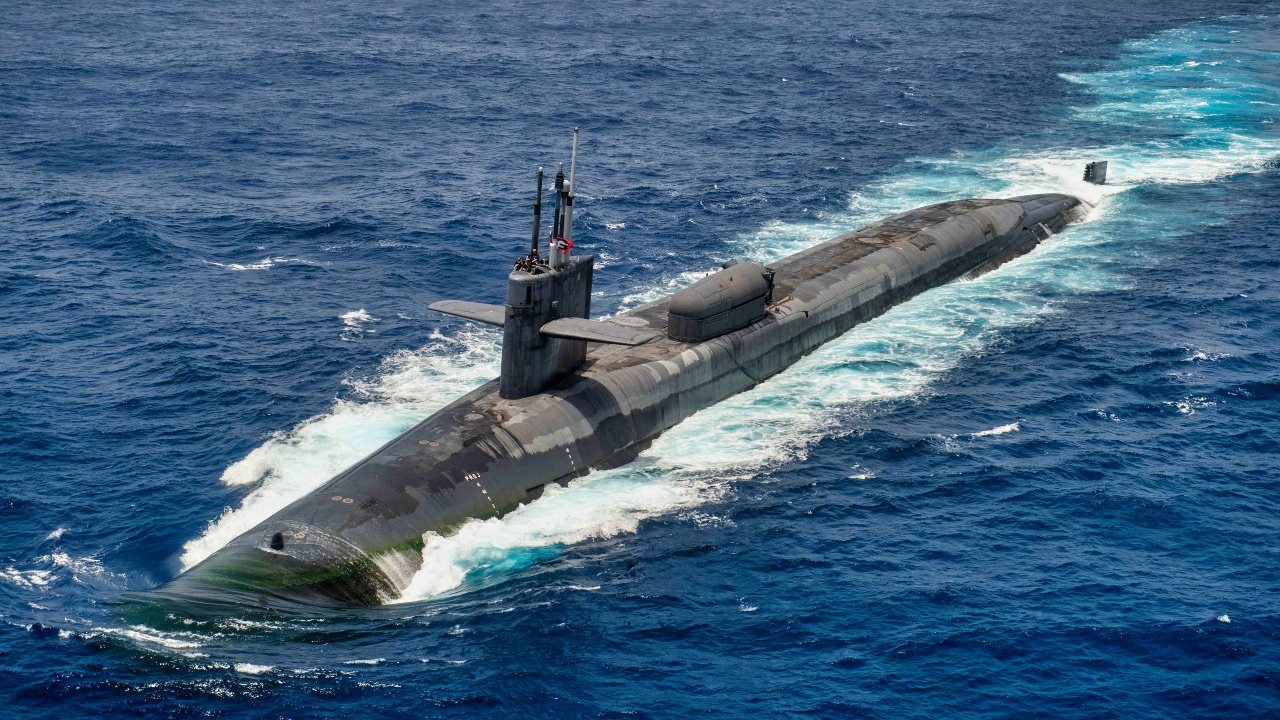
An Ohio-class ballistic missile submarine — the platform that carries the Trident II D5 SLBM. The U.S. Navy operates 14 Ohio-class boats, each capable of carrying up to 20 Trident missiles. The Columbia class, entering service in the early 2030s, will carry 16 missiles in four quad-packs. Photo: U.S. Navy.
🟡 The UK Dimension
Britain’s Independent Deterrent Is Not Independent — The Polaris Sales Agreement and What It Actually Means
The Foreign Military Sale component of this contract renewal cuts to the heart of a long-standing debate in British defence policy. The UK operates its Trident missiles under the 1963 Polaris Sales Agreement and its 1982 amendment, which established a framework in which the United States supplies the submarine-launched ballistic missiles while the UK builds its own submarines and manufactures its own warheads. The arrangement is frequently described by UK government ministers as an “independent” nuclear deterrent.
In practical engineering terms, British Trident operations depend on shared missile bodies, a common logistics chain, shared test facilities in the United States, and now — as this contract illustrates — shared engineering support provided by BAE Systems across both fleets from the same Maryland-based operation. British warheads are UK-designed, but the missiles they ride, the submarines they launch from, and the engineering infrastructure sustaining the system are all deeply intertwined with U.S. programmes.
This interdependence is a deliberate feature, not a flaw. It binds the two nations’ nuclear postures together technically, creating a shared incentive to sustain the system and reducing the UK’s standalone development costs. The forthcoming Dreadnought-class submarines — intended to replace the Vanguard fleet from the early 2030s — will use the same Trident II D5 missile, continuing this architecture for at least another generation.
Programme Context — U.S. Navy Strategic Systems Programs
The Trident II D5 Life Extension programme is intended to maintain the credibility of the sea-based deterrent through the 2040s and beyond — ensuring that both the U.S. and UK maintain a continuous at-sea presence with a fully reliable, fully accurate system capable of penetrating any adversary defensive architecture.
Strategy Battles Assessment
The 51st Modification Tells You Everything About How Nuclear Deterrence Actually Works
The number that matters in this story is not $45.5 million. It is 51. Fifty-one consecutive modifications to a single BAE Systems contract for Trident engineering support represents something that defence budget lines rarely capture: the absolute continuity of requirement that defines nuclear deterrence as a programme discipline. You do not competitively bid the engineering safety layer of your strategic deterrent every few years. You build a relationship, deepen it, and keep modifying it because the alternative — a gap in expertise — is a risk no government will accept.
The timing of this award is worth noting. It arrives as the U.S. and UK prepare to launch Trident Increment 8 navigation upgrades in October 2026, with Columbia-class submarines approaching initial operational capability, and in a broader strategic environment defined by Russian nuclear posturing over Ukraine and Chinese nuclear expansion at a pace that has alarmed U.S. Strategic Command. The West’s response to that environment is not new weapons — it is continuous, methodical modernisation of the systems it already has, ensuring they remain penetrating, reliable, and credible against any future adversary defensive architecture.
For the UK, this contract also quietly illustrates the real meaning of the British “independent” nuclear deterrent. Independence at the strategic level — the authority to launch without U.S. permission — is real. Independence at the industrial and engineering level is not. BAE Systems’ Rochester facility, Lockheed Martin’s Sunnyvale production line, and the test range at Cape Canaveral are as fundamental to the UK’s deterrent posture as the HMS Vanguard herself. That is not a vulnerability; it is the architecture of an alliance that has held since 1963. But it is a fact that any serious analysis of British nuclear policy must account for.
Strategy Battles — Related Coverage
Sources
- BAE Systems wins $45.5M deal for Trident II missile engineering work — Defence Blog, April 23, 2026
- U.S. and UK Reinforce Trident II D5 for Joint Nuclear Deterrence — Army Recognition / Erwan Halna du Fretay, April 23, 2026
- U.S. and UK Navies to Begin Trident II D5 Modernisation in 2026 — Army Recognition, November 2025
- U.S. Navy Funds Trident II Fire Control Upgrade — Interesting Engineering, March 2026
- Lockheed Martin Secures $850M Trident Contract Modification — Executive Biz, April 2026
- Trident D5 Missile Profile — CSIS Missile Threat Database
- UGM-133 Trident II — Wikipedia (technical specifications and test history)
- Fleet Ballistic Missiles — Lockheed Martin Strategic Systems
Editorial Verification
Verified: Contract award value ($45.5M), contract modification number (51st), contracting activity (PAE Strategic Systems Programs), programme scope (Trident II D5 Strategic Weapon Systems, Attack Weapon System, Nuclear Weapon Security), task disciplines (systems engineering, test, data analysis, safety), performance end date (September 30, 2026), Foreign Military Sale to UK, work locations including Rochester UK. Programme context figures (Increment 8, General Dynamics $255M, Lockheed Martin $850M) sourced from separate publicly disclosed contracts and reporting. Ohio-class missile count, Vanguard-class missile count, and D5 technical specifications sourced from CSIS Missile Threat database and Wikipedia.
Not Reproduced: Warhead yield specifics, targeting parameters, classified submarine patrol data, or any information not publicly disclosed by the U.S. Department of Defense or open-source technical databases.
Approved for Publication / Marcus V. Thorne — Lead Editor, StrategyBattles.net — April 24, 2026
© StrategyBattles.net 2026. All rights reserved. This article is produced for informational and analytical purposes only. Classified information has not been reproduced. All contract figures are drawn from publicly available U.S. Department of Defense announcements and open-source defence reporting.