
US Weapons Stockpile Depletion: Iran War Drains Arsenal Faster Than Industry Can Rebuild
1,100+
JASSM-ER stealth cruise missiles expended
1,000+
Tomahawk missiles fired — approx. 10x annual buy rate
1,200+
Patriot interceptors fired — $4 million each
13,000+
Targets struck — multiple munitions per target
$5.6bn
Munitions expended in first 48 hours alone
$35bn
Estimated total war cost — up to $1bn per day at peak
🔴 The Drawdown — Scale of Munitions Expended
One Month of Combat Has Consumed Close to a Decade of Procurement in the Most Critical Weapons Categories
In just over a month of sustained air and naval operations against Iran, the United States has burned through quantities of high-end precision munitions that would, under normal peacetime procurement schedules, take the better part of a decade to replace. This is not a marginal overspend on a single weapons category. It is a structural gap between wartime consumption rates and an industrial base that was never sized for a conflict of this intensity, pace or duration.
More than 1,100 JASSM-ER stealth cruise missiles have been expended in the campaign. These are not general-purpose bombs pressed into service under operational pressure. The JASSM-ER is a purpose-built, long-range, stealthy stand-off weapon specifically designed for penetrating sophisticated integrated air defence systems — held in reserve for potential high-end conflict with China or Russia. That they have been used in volume against Iran says something significant about how seriously CENTCOM assessed the Iranian air defence threat and how demanding the strike requirements against deeply buried and dispersed targets proved to be.
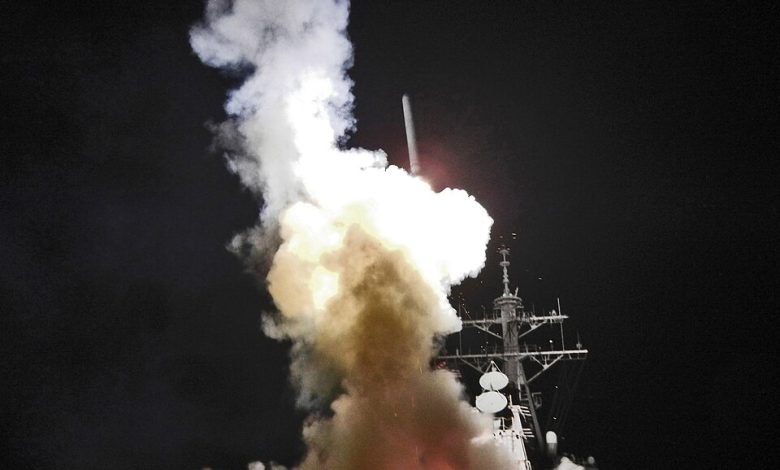
More than 1,000 Tomahawk land-attack cruise missiles have also been fired. Pre-war U.S. annual procurement ran at approximately 100 units per year, meaning the campaign has consumed the equivalent of roughly a decade of purchases in weeks. Alongside these, over 1,200 Patriot interceptor missiles have been launched at an individual unit cost of approximately $4 million each, at a rate that far exceeds annual production capacity and draws on stockpiles that were already below stated readiness thresholds before the first strike landed.
Senator Jack Reed — Senate Armed Services Committee
“At current production rates, reconstituting what we have expended could take years.”
🟡 The Production Problem — Why the Gap Cannot Be Closed Quickly
The Weapons Being Consumed Are the Most Complex to Manufacture in the Entire U.S. Inventory — and the Supply Chains Cannot Be Rapidly Surged
The production problem is not simply one of will or funding, though both are factors. JASSM-ER, Tomahawk and Patriot interceptors are among the most component-intensive and lead-time-dependent weapons in the U.S. inventory. Their supply chains involve specialised electronics, propulsion systems and precision guidance components that cannot be rapidly sourced or surged. A decision made today to double production would take 18 to 24 months to register as additional units available on the stockpile shelf.
Mark Cancian, senior adviser at the Centre for Strategic and International Studies, confirmed what defence planners had privately known for years: several of the most critical munitions categories were already running below required levels before the war began. The Iran campaign has not created a new vulnerability — it has accelerated and deepened a pre-existing one that had been partially obscured by the absence of a conflict large enough to expose it. The specific shortfall categories are exactly those weapons most relevant to deterrence in the Pacific and on NATO’s eastern flank.
The Pentagon has initiated discussions with Raytheon, Lockheed Martin and other prime contractors about expanding production capacity. But officials acknowledge the expansion has not yet begun in earnest, partly because congressional appropriations — the money needed to fund multi-year production contracts — have not moved at the required pace. Industrial capacity follows contract awards. Contract awards follow funding. That sequencing cannot be bypassed regardless of the urgency of the operational requirement.
Mark Cancian — Centre for Strategic and International Studies (via NYT)
“The United States has many munitions with adequate inventories, but some critical ground-attack and missile-defence munitions were short before the war and are even shorter now.”
🔵 Global Deterrence — Strategic Consequences Beyond the Gulf
Patriot Batteries Pulled From South Korea. Carrier Groups Diverted From the Pacific. The Trade-Offs Are Not Theoretical — They Are Operational.
To sustain operations against Iran and protect allied assets in the Gulf region, U.S. military planners have had to make concrete choices about where scarce missile defence assets are deployed. Patriot and THAAD battery systems previously positioned to counter North Korean ballistic missile threats and to underwrite deterrence commitments to South Korea have been redeployed to the Middle East theatre. That is a direct and measurable subtraction from Indo-Pacific Command’s defence posture — not a theoretical risk but an already-executed reallocation.
The same logic applies to Europe. NATO’s eastern flank deterrence architecture rests partly on the assumption that U.S. precision strike and missile defence assets are available in depth when needed. European commanders are now working with stockpiles further drawn down by the Iran campaign, on top of years of transfers to Ukraine that had already reduced inventory levels below alliance readiness benchmarks. The combined effect is a shallower magazine across the board at precisely the moment Russia continues to prosecute a full-scale war on NATO’s border.
A U.S. commander acknowledged the constraint directly in congressional testimony, stating that “there are finite limits to the magazine.” That statement from inside the military chain of command is not alarmism. It is the language of logistics officers confronting real inventory ceilings in an active high-intensity conflict, and it deserves to be read as such.
🟡 The Financial Reckoning — What High-Intensity War Actually Costs
$5.6 Billion in the First Two Days. A Doctrine Built on Expensive Precision Weapons Confronting the Reality of a Prolonged Campaign.
Independent analysts estimate the total cost of the Iran campaign has reached between $28 billion and $35 billion as of late April 2026, with the conflict running at close to $1 billion per day at peak operational intensity. In the first 48 hours alone, an estimated $5.6 billion in munitions was expended. These are not official Pentagon figures, which remain classified, but they are grounded in open-source analysis of known weapons systems, reported unit costs and sortie rates confirmed by multiple outlets. They should be read as indicative ranges rather than precise accounting.
The financial profile of the campaign has exposed a deeper doctrinal question: whether the U.S. military’s preference for expensive, precision-guided long-range munitions is sustainable in conflicts that extend beyond the short, decisive operations that preference was designed for. Other militaries — notably Iran itself, Russia and increasingly China — have invested heavily in large volumes of cheaper one-way attack drones and simplified munitions that can be produced at genuine industrial scale. The U.S. has used drones in this conflict, but its signature strike weapons remain priced in the hundreds of thousands to millions of dollars per unit.
That doctrine made operational sense against outgunned adversaries in permissive environments where volume of fire was never the binding constraint. Against Iran — a country with geographic depth, dispersed and hardened infrastructure, and a missile arsenal capable of meaningful retaliation — it has imposed financial and material costs that the defence industrial base was not resourced to absorb at this pace.
🔴 Political Response — The White House vs. Congress
The Administration Denies a Problem That Bipartisan Congressional Testimony Has Already Put on the Record
The Trump administration has pushed back hard against stockpile reporting. White House press secretary Karoline Leavitt stated that “the entire premise of this story is false,” insisting the U.S. military remains fully capable of meeting any operational requirement. The Pentagon has declined to release detailed munitions expenditure data on operational security grounds — a procedurally defensible position that is also politically convenient given the figures emerging through independent analysis and congressional testimony.
The bipartisan character of congressional concern carries weight. Senator Jack Reed is not a partisan critic. He is one of the most senior and defence-experienced members of the Senate, regularly briefed at classified level by the services and the intelligence community. When a figure of his standing states publicly that reconstitution could take years, that assessment is not derived from press reporting. It is grounded in what the military has told the oversight committees under oath.
The precise distinction that should not be lost: the United States is not running out of weapons in any absolute sense. The concern is category-specific, focused on long-range precision strike missiles and missile-defence interceptors — the weapons classes most relevant to deterrence of China and Russia in a major conflict scenario. The overall military remains formidable. But the specific capabilities that underwrite the most demanding deterrence commitments are now shallower than they were in February 2026.
Strategy Battles Assessment
The weapons depletion story and the separately reported Iran arsenal retention story are two halves of the same strategic picture. The United States struck Iran harder and more extensively than any air campaign in a generation and still did not destroy the arsenal it was targeting. It has simultaneously consumed its own most advanced weapons at a rate the defence industrial base cannot immediately replenish. Both facts point in the same direction: the material balance of this conflict is less one-sided than the public posture of the administration suggests, and the costs will extend well beyond the ceasefire.
The Indo-Pacific dimension demands particular attention. U.S. deterrence of China rests not just on declared capability but on the credible threat of sustained, long-range precision strike in a contested anti-access environment. JASSM-ER and Tomahawk are the specific weapons that make that threat credible at the ranges required in the Pacific. Both have now been expended in volume in the Middle East. Beijing has been watching this campaign with the attentiveness of a serious military power running its own lessons-learned analysis. It will draw conclusions about U.S. magazine depth, reconstitution timelines and the feasibility of sustaining simultaneous crises in two geographically separated theatres. Those conclusions will inform its own calculus on Taiwan and in the South China Sea in the months and years ahead.
The production problem is technically solvable — but solving it requires sustained congressional funding across multiple budget cycles, defence contractor capacity investments that take 18 to 24 months to generate additional output, and a doctrinal rethink about whether the U.S. military’s low-volume, high-cost precision weapons preference remains viable in prolonged high-intensity conflict. None of those solutions arrive quickly. The window between now and meaningful stockpile recovery is the period of greatest strategic risk, and the risk is compounded by the fact that the adversaries most likely to probe that vulnerability are the ones with the best intelligence picture of how deep the drawdown actually goes.
Strategy Battles — Related Coverage
Sources
- Gulf News / Alex Abraham — Is the Iran War Depleting US Weapons Too Fast? (April 24, 2026)
- Gulf News — 850 Missiles in 4 Weeks: What the Iran War Is Costing the US
- The New York Times — U.S. Munitions Consumption and Stockpile Drawdown Reporting (April 2026)
- Centre for Strategic and International Studies — Mark Cancian, Senior Adviser, munitions shortfall analysis (cited via NYT, April 2026)
- Gulf News — US Power vs Iran Leverage: The Real Battle in the War
- Gulf News — US-Iran War Clock: May 1 Deadline Puts Trump Under Pressure (April 2026)
Editorial Verification
JASSM-ER (1,100+), Tomahawk (1,000+) and Patriot interceptor (1,200+) expenditure figures are sourced to The New York Times reporting cited by Gulf News / Alex Abraham, April 24, 2026. The 13,000+ targets figure is confirmed by multiple outlets citing Pentagon statements. The $5.6bn first-48-hours munitions estimate and total war cost range ($28bn-$35bn) are independent analyst estimates as reported by Gulf News — these are not official Pentagon figures and are characterised as such throughout this article. Senator Reed quote is from on-record Senate Armed Services Committee testimony. Cancian (CSIS) quote is via NYT. Karoline Leavitt denial is on-record White House press briefing. Patriot and THAAD redeployment from South Korea is sourced to NYT. The Tomahawk annual procurement comparison (approx. 100 units per year) is drawn from publicly available U.S. defence budget documents. Original editorial analysis by Strategy Battles.
Approved for Publication
Marcus V. Thorne
Lead Editor, Strategy Battles
©StrategyBattles.net 2026
This article is for news and analysis purposes only. Based on publicly available news sources and military updates. All rights reserved. Not for commercial reuse without permission.